 Fourteen years later, the Birmingham production of Stockhausen’s Mittwoch aus Licht is still fresh in my mind. I was persuaded by a friend to go to Berlin to see this new production staged by Le Balcon, the French company which has been steadily working its way through the entire Licht cycle with insightful, imaginative productions based on relatively limited resources. The main motivation was to see how they interpreted the theme that underpins Mittwoch: a double image that both celebrates humanity’s ability for aspirational cooperation, while also judging it as inadequate without devotion to the divine forces of the universe, as personified in the opera cycle by Michael, Eva and Lucifer. As other critics had observed, the Birmingham version tended to focus on the optimistic side, with only faint insinuations of the more sinister undercurrents that appear throughout the opera. The performance was held at the Deutsche Oper, which already implied limitations in how the opera would be presented; confined to a proscenium arch with the audience looking on, the staging would not have the immersive qualities envisioned by Stockhausen in his conceived opera for the future. In a way, it appeared Le Balcon were going to press this to their advantage, emphasising that the activities we witnessed were compromised and incomplete.
I’ll start with the helicopters, since that’s what everyone always wants to talk about. They were, of course, not presented live on-site as they were in Birmingham – we were deprived of that spectacle. We were given a replay of the event, staged earlier in the month by four pilots with camera crew and the slightly apprehensive-looking string quartet of the Deutsche Oper taking to the skies in the fields outside Berlin. By way of introduction, we heard Stockhausen speaking before the world premiere some thirty years ago. The sound mix was loud, hot, the strings straining to be heard over the chatter of rotor blades and the roar of the engines; it buffeted the audience with a constant barrage of noise for half an hour. When the score called the musicians to recite numbers, they instinctively bellowed them out above the din, without consideration of aesthetic refinement. The quartet appeared as beaten down as the audience felt, each looking very cramped and claustrophobic in their small cabin; their brows with unrelieved expressions of concentration on the task at hand. It was an atmosphere of highly controlled desperation. Helicopter-String Quartet is often described as an analogy for space travel; at the Deutsche Oper we were reminded that the act itself is a difficult, rigidly disciplined and exhausting chore. Perversely, these reasons made it the best performance of the work I’ve ever experienced.
That feeling of generalised anxiety pervaded the entire opera. What exactly were we witnessing? Birmingham Opera gave the work a carnivalesque staging, complete with additional dance and theatre during the initial Greeting and the concluding Farewell. More detached in Berlin, we observed. Deutsche Oper’s chorus gave a superb rendition of the choral Welt-Parlament, backed by a rather unpleasant video animation of rippling and cascading sand, partly blocked by a large piece of modernist public sculpture. The sculpture and video projections remained throughout, the animations all sharing the same quality of either very out-of-date computer graphics or almost up-to-date artificial intelligence rendering. The unstable, hallucinatory images started to grow on me during the night as their slippery, insubstantial attempts at appearing real became a thematic element with growing importance. Le Balcon’s ensemble performed Orchester-Finalisten under dim lighting, the soloists scattered listlessly about the stage, stirring into action when needed, gaining enthusiasm only when it was their turn to lead. The accompanying collage of sounds that plays through the scene was again mixed very high, blurring the difference between what was played live and what instrumental sounds came from the soundtrack. Human figure and video image became harder to distinguish, the real became illusory. Over each successive solo, a trend towards diminishment and entropy became noticeable. The Helicopter String Quartet followed immediately, without a break.
Le Balcon provided the singers and the musicians for Michaelion, the long, strange scene that concludes the action. The mystery play aspect to Stockhausen’s operas was most obvious here, just as the exact argument he is presenting remained obscure. Heroically committed performances by the soloists and some bizarre pageantry held the audience’s attention while the scene progressed in the unhurried manner of later Stockhausen, but you kept wondering where it was all leading. A low state of anxiety had steadily built up during the night, so that the ambiguously-framed conclusion of the opera became more stinging in its lack of neat resolution. It ends with hopes; hopes that people can follow the principles of Michael and Eva and that Lucifer may work with them, which are high hopes indeed. Cynicism has no place in Stockhausen’s reality but in this production it’s hard to look at the scene’s ending in any other way: whereas hope is typically a positive note on which to end a drama, in this case it arrives as a settlement, unsatisfactory but the only workable alternative. Was it all too negative? Perhaps, acting as a counterpoint, yin to Birmingham’s yang. I doubt if it’s possible for an ideal interpretation of Mittwoch to be imagined, let alone performed. Both stagings I’ve seen had their own, opposing ways of warping your perception.
Filed under: Music, Reviews by Ben.H
Tags: Karlheinz Stockhausen
No Comments »
Jules Reidy: Clerestory
Monday 21 September 2026
 Jules Reidy: Clerestory [Thrill Jockey]. Reidy continues to develop a subtle but sophisticated form of tonality in the two pieces paired on this album, all originating from the unprepossessing source of playing acoustic guitar. Clerestory follows on from Instants & Their Echoes, further expanding the palette of sounds while keeping a coherent but pronounced concept of tuning. The first piece is Shadow Symmetric, commissioned and performed by the JACK Quartet as a result of their recent round of workshopping sessions. A straight-up, unadorned acoustic quartet, in which Reidy builds upon a simple, harmonious texture by alternating between two sets of just intonation scales, each fairly normal in themselves but with enough divergences between them to create a perceptible tension between consonance and dissonance as the Quartet moves from one chord to the next. The steady pace, evenness of dynamics and lack of vibrato suggest a concert of viols, and the slightly grainy, rusticated harmonies add to the impression of music arriving from somewhere outside of time. The JACK musicians know their just intonation and don’t need to make heavy work of hitting the unusual pitches specified by Reidy. You could crank it up to get the full effect of the strange harmonics but it works better as a quiet piece, seemingly still on the surface but faintly bustling in its depths.
Clerestory Windows is the counterpart, where material from the quartet is repurposed into a fixed media work for various electronics, complemented by Reidy’s guitar. The inspiration comes from a sound installation for transducers attached to suspended panes of glass, and so the piece is a set of shadowy, translucent echoes of the original. MIDI instruments produce the pitch-perfect harmonies in thin, glossy tones, slightly off-putting in their falsified timbres – it’s a nice homage to a previous generation of musicians working with microtonality. Later, some early digital synths recover some of the material, adding to the nostalgic futurism. This suite of inventions on the quartet’s material are given substance by the intervention of Reidy’s signature steel-stringed acoustic guitar, with playing that is simple and direct but dazzles with the glittering timbre of the strings. The lightness and brightness come as part of the mediation between real and virtual sounds, creating a double image where the electronics are both a representation of the harmonic sonorities and its embodiment.
Filed under: Music, Reviews by Ben.H
Tags: Jules (Julia) Reidy
No Comments »
Gentle Fire: Further Explorations
Friday 18 September 2026
 Gentle Fire: Further Explorations [Paradigm Discs]. I called Explorations, the first Paradigm issue of Gentle Fire recordings, an example of all that is best in archival box sets, combining historical interest and importance with a compelling and exciting listening experience. Further Explorations extends the previous collection with a single disc of performances recorded by German radio in 1973 and 1974. The group, musician/composers Richard Bernas, Hugh Davies, Graham Hearn, Stuart Jones and Michael Robinson, play a combination of conventional instruments, electronics and home-made instruments. Yeah, they’re British but they also worked closely with Stockhausen (Sternklang) and so their ways of making music are an intriguing hybrid of the empiricist, do-it-yourself methods espoused by the Scratch Orchestra and the abstract or mystical idealism that directed improvisations under the European avant-garde. This permits them more than a single dimension to their playing, allowing for interpretations of these very open scores that question and play with the assumptions upon which these compositions operate, whether expecting rigour or anarchy, high seriousness or sly irreverence: there’s a bit of everything in the way they tackle these pieces, without resorting to making the vehicles for their own ideas. The new face amongst the composers here is the late Erhard Grosskopf, whose Looping 1 begins the album. Composed for the ensemble, the piece is built out of playback of tape loops of filtered electronic tones and speech, which the musicians must match with suitable harmonic relationships. This gives it an unusual consistency, as though the piece is all straight-through playback, with a fixed, minimal texture. The voice fragments are electronically treated and distorted, gradually becoming clearer. The text is, almost inevitably, by Mao Zedong, as period-perfect as a Raleigh Chopper.
Graham Hearn’s Art Must Be Fed sets the musicians randomly-selected tasks to perform, either to play something “badly” or sing, hum or whistle some remembered music from elsewhere. The wonky, humorous nature of the piece is tempered and made more poignant by the gentle pacing of the work, guided by a slow, repeating piano phrase that resembles the beginning of a Satie piece that never gets going, enhancing the atmosphere of melancholy absurdist theatre. Their rendition of Christian Wolff’s perennial Edges is a different performance from the London EMI recording from a few years earlier and shows the group’s interpretative chops in a more conventional light. While very different, both pieces require their performers to make decisions on the fly, where the given instructions are unstable, flexing back and forth between acting as a waypoint and a limit. The two group compositions are striking in the way they take a monolithic premise and then build variations out of it. Group Composition III is made by the ensemble as it goes along, each musician working on a gong tree built by Michael Robinson, using methods roughly similar to those in Stockhausen’s Mikrophonie I. The surfaces are worked over with various mallets and microphones to create an extended abstraction of resonant metallic sounds shaded by reverberation and filtered noise. It’s with this piece that you realise how much modern free composition and improv is still modelled on these performances from over half a century ago. In Music Project V-II, the numbers refer to intervals in the traditional diatonic scale; in short, it’s a pop vamp stretched and stripped to its barest essentials of hovering between dissonance and resolution. Like an early, unexplored path of minimal composition, it takes a simple idea and transforms it by taking it in an unexpected direction, finding strange sounds in a confined harmonic space. The conception of the piece, as something so open and irreducible as to defy authorship, produces something that sounds like something quite different from any other possibly related works from this time.
The sound quality is as good as you would expect from 1970s West German radio production, perhaps a little dry in places, which was the style at the time for presenting new music. None of these recordings have had a legitimate commercial release before now, so this will sound better than that untagged MP3 you downloaded from some blog years ago. The accompanying notes and booklet are again excellent and informative, including the original programme notes from the concerts and a radio talk given at the time by Michael Robinson, in whose memory this album is dedicated. It’s another step towards recovering a past which is still felt today but is not yet fully recognised.
Filed under: Music, Reviews by Ben.H
Tags: Christian Wolff, Erhard Grosskopf, Gentle Fire, Graham Hearn
No Comments »
Some older stuff I had saved but forgot about (2)
Tuesday 15 September 2026
 Vilhelm Bromander: aurora [Warm Winters Ltd.]. Well this is all quite lovely. I think I found its charm truly ineffable and so refrained from trying to write anything intelligent about it. A suite of short pieces for a septet of winds, brass, low strings and pump organ. The modesty of its expression comes from the quiet formality of its presentation and the slightly scuffed ensemble playing in its execution. Subversive in its self-effacement, rather like those new British composers from the 1970s. In fact, the musicians here are mostly playing instruments unfamiliar to them: Bromander for example usually plays double bass, as heard on the equally surprising ...for some reason that escapes us. Here, he’s on soprano sax and organ duties. They’re not the Portsmouth Sinfonia, but as they ring the changes on these cascading chorale-like pieces, they do evoke the dignified amateurism and communal pride that the Scratch Orchestra aimed for.
 Jackson Greenberg: Apartments from Sybarite5: Collective Wisdom [Bright Shiny Things]. Throwing out a pile of emails I found Greenberg’s The Things We Pass On Through Our Genes from 2023, a piece which started out as a string quartet recorded in 2012. Ten years later Greenberg fed the recording through effects pedals and other processes, playing through the piece live to tape. The sleeve notes say it was therapeutic, and the spontaneity of the treatments can diminish the uncanny quality that sometimes emerges in favour of raw texture, leaning into authenticity over more profound communication with the listener. More effective is Apartments, a 2023 composition for string quintet with tape loops and live AM radio, played with poignant wistfulness by the ensemble Sybarite5. The radio inevitably creates a melancholy mood, something familiar yet distant and unattainable. The simple part for strings supports the elegiac and reflective atmosphere, while delicate flourishes of electronics act both as alienation and enhancement of the feeling of emotional displacement. Made to be played while looking out the window on a rainy day.
 Christopher Whitley: almost as soft as silence [self-released]. Critics (me) could get in a cheap shot about Whitley thinking too hard when commissioning violin pieces, going by his adventurous if flawed Describe Yourself from a few years back. I should point out that he followed it up with an album going the opposite direction, by simply playing with as little thought as possible. The fifteen tracks on the sub-thirty minute almost as soft as silence are the merest slips in the wind, blowing past the ear with felicitous facility. Title track excepted, nothing feels fragmentary or self-aware about form (no deconstruction here) as each piece is absorbed by technique while seeming to be effortless. Pleasant to an almost baffling degree, and it’s only in the last track you feel you’ve heard something substantial. It all sounds lovely, what with Whitley being darn good and the instrument a loaned Stradivarius, which I suppose obliges him to play nice.
 Jeff Kimmel & Jack Langdon: The other side of the air [Dinzu Artefacts]. I’ve just been listening to a few releases by Low Impact, including Jeff Kimmel’s In Plain Sight and Exhausted Mechanisms by Kelley Sheehan and Jack Langdon. Both were a little fiddly for my tastes, but I remembered those names: early last year Kimmel and Langdon released The other side of the air, a set of duets for clarinet and organ. It’s one of those cute little miniature pipe organs, matched by Kimmel playing clarinet with as little affect as possible. The whole thing was recorded in one session. In the first piece, Langdon plays chords without quite enough air, adding microtonal shifts as the intonation falters, rubbing up against the slow, careful clarinet melody. For the second piece they shift to suspended unisons, where the beating frequencies and halos of overtones become foreground material. From here and for the rest of the set the two spread out to explore the same phenomena in wider pitch ranges and discovering new timbres along the way. Between the two of them they may sound like a recorder ensemble, a chorus of ocarinas or a blown set of bottles, building up these pallid but unstable colours to create fascinating variety from increasingly immobile playing.
Filed under: Music, Reviews by Ben.H
Tags: Christopher Whitley, Jack Langdon, Jackson Greenberg, Jeff Kimmel, Vilhelm Bromander
No Comments »
Pianos: Eldritch Priest, Linda Catlin Smith, Emilie Cecilia LeBel
Sunday 13 September 2026
 Eldritch Priest: Too, So Like Nothing [Halocline Trance]. Three piano pieces by Eldritch Priest, played by someone else. …soot?aporia from 2005 begins with a stutter and seems to be breaking down before it’s even begun, and the fleeting, fragmentary nature of the piece carries on from there, finding the most unlikely continuity out of the abrupt positioning of stumbling chord sequences, delicate arpeggios and unequal phrases of unexpected tenderness. The someone else playing is Roger Admiral, who interprets EP’s jostling, angular movements with supreme felicity and tact. All three pieces share a louche, hazy nocturnality under Admiral’s hands as he finds the undercurrent of cool late-night jazz beneath the surface agitation. In …soot?aporia he sounds like Milton Babbitt playing a cocktail lounge: the textures are more relaxed but shares the phrasing that seems erratic disguises a canny understanding of the flow of time against rhythm. nape…wrinkle…linger is a shorter work from 2002, more open in its texture and so more tractable for the listener’s sense of direction. Admiral plays it all with a loving touch and delicious sensuality; he insinuates jazz impressions out of supple technique, even more than the compunded harmonies do. The title piece is a later work from 2020: the same tricksy energy is less obvious, but still present in a more refined form. On the album, it seems to find a balance between the two preceding tracks, and Admiral still manages to rhapsodise at fascinating length upon recondite musical language.
 Linda Catlin Smith: The Complete Piano Solos (1989-2023), Volume 2: The Underfolding and Early Works [Redshift]. After Volume 1, dedicated to the recent, hour-long The Plains, Cheryl Duvall turns her attention to Smith’s earlier pieces: The Underfolding is from 2001 and the remaining eight pieces are short works from the last century. These are generally less well-represented on record than her later stuff, so to hear a collection of them gathered together affords a glimpse into a world of inspirations and influences which have shaped her present work. Some time ago, it took me a while to get a bead on where Smith was coming from; as heard in this collection, she spent the Nineties trying to find a clarity of language, which I had first assumed was a pose of folksy simplicity. That clarity is produced in different ways: Poire is deconstructed Satie, Iceberg isolates rising arpeggios from one of Bach’s Goldberg Variations. The earliest work here is Zart, a homage to Feldman by way of Schoenberg, making use of touch, attack and decay to dwell upon clotted harmonies; the surprising variety of dynamics and cut-off of resonances also appear in 1990’s Music For John Cage, clarified both in technique and harmonic language. Duvall plays these pieces with a directness, even bluntness, the stark dynamics and clean attacks giving it an unvarnished sound – that may seem like I’m gearing up to use ‘folksy’ again but that doesn’t apply here. Duvall’s directness takes on the appearance of attempting to explicate Smith’s various methods, but in fact conceals questions of compositional technique behind the need to show the unity of a common goal which unites these works. 1999’s For Udo Kasemets is another tribute piece, where Smith honours the dedicatee by adopting a system of permutations and yet she and Duvall produce a piece which sounds warm and intuitive; the earlier Bloom is also dedicated to Kasemets and shares qualities with Smith’s pieces for Feldman and Cage. In all of this experimentation, it’s really only The Surroundings from 1995 which left me cold, sounding a little too stark and formulaic in this company. The key work to understanding Smith’s later music is The View From Here, a 1992 composition that eschews direct references, systems and intellectual querying to instead rely on personal experience, not as a means of self-expression but as a means of contemplation. The assimilation of all these tendencies can be heard in The Underfolding, which slowly roils and churns through successions of dense chords for 22 minutes, maintaining an internal calm even as it never reaches a point of balance or stability. At times the pace slows or pauses, lingering on a particular sonority before continuing as before. The tension and relaxation in the piece feels like an organic process, yet still leaves the listener with the memory that the piece was more difficult and disturbing than it seemed at the time. Duvall’s head-on approach comes through here, neither overstating nor soft-pedalling the confrontations contained within the piece.
 Emilie Cecilia LeBel: Landscapes of Memory [Redshift]. I described LeBel’s earlier field studies as admirably spare in places but susceptible to moments of fussiness. The two halfhourish pieces on Landscapes of Memory are both composed for piano with e-bow drone. Ghost geography, played by Wesley Shen, focuses on a figure which articulates a repeated chord, followed by a high single note. This gets elaborated upon, but gently. The bowed piano string acts as pedal point and sounding board for the decaying chords and pitches, giving additional colour to each iteration of the chords. Later, there is a dramatic flourish, characteristic of LeBel, with loud arpeggiated chords and then some hushed inversions of the opening motif. The dramatic effects sought after by the composer are based in sonority more than any direct theatrical reference and so appear more focused and coherent than in the previous collection I’ve heard. Pale forms in uncommon light was composed a year later (2023) and is played by Luciane Cardassi. It’s equally slow and deliberate, as you would expect in making the overtones heard against the drone. The bowed string is a higher pitch and the figures played by Cardassi are a bit less reticent, allowing a hint of chord progressions, cadences or melodic fragments to appear; as such, this piece is in five named sections which explore each of the immplicit facets a little further. They’re not the easiest pair of compositions to get along with, each being very sombre throughout, but they are two serious attempts to make expressive music out of psychoacoustic phenomena, without resorting to cheap drama.
Filed under: Music, Reviews by Ben.H
Tags: Eldritch Priest, Emilie Cecilia LeBel, Linda Catlin Smith
No Comments »
Diez Fischer, Granberg
Monday 31 August 2026
 Santiago Diez Fischer: Songs [Another Timbre]. Kept meaning to write about this one but it always seemed a formidable task. It starts out simply enough, with and your mouth is like the sound of many waters, a grave but mellow baritone sax tracing out a slow, looping line over atmospheric electronics; then it all goes to hell. The backing track stutters and breaks up, the sax barks back, then when everything has fallen back into place the music is a shadow of what it once was. The following pieces are even more disturbed, making poetry out of harsh, battered sounds; like a lovingly rendered and deeply-hued portrait of a bruised thumb. I had to double-check I was listening to the right record because this does not sound like an Another Timbre release. At its extreme, the poetically-titled under the redwood tree begins with an obtrusive noise floor and ekes out harmonics and partials from the hollow resonances obtained by grinding and striking metal objects against a pair of snare drums, punctuated by growls and bursts of static interference until it’s all taken up with the persistent buzzing from a prepared electric razor. The piece resolves, if that’s the right word, with muffled, wordless singing, without accompaniment. The description does not do justice to the sonic and evocative depths the musicians find in this hostile materiel. tres ciegos, an earlier work, keeps the sax and adds accordion, bowed student guitar and Tupperware containers of various sizes, making for a brooding study in low timbres that swells and ebbs away, the grain of the brass and reed rubbing up against the groaning sounds of bowed plastic and strings. The musicians also vocalise, thickening out a compound sound that threatens to become a tonal miasma but somehow retains definition. You start to realise Diez Fischer is composing in a grey zone somewhere between the arrangement of pitches and the pure timbre of noise, where the conventional elements of music are always present, however faint it may be at times, but complicated by the messy physical processes of producing sound. The Gyre Ensemble is the trio who play on all of the pieces here, showing enthusiasm and inventiveness as they tread the fine note-v-noise line laid out by the composer. rise in the sky to be a reminder of comfort says it’s for solo accordion and electronics but sounds at first like a duet for accordion and bowed cardboard, with lots of higher, purer-sounding reeds producing near sinelike tones from the acoustic instrument while the electronics get dirty. The two elements merge and then swap places, with more guttural sounds pitched against unsteady synthesised chords. The final trio, Sappho’s song, uses more complex forces including “voltage controlled fan preparation of student recorder” to evoke a submarine tableau of deep, wafting organic forms that slowly rise against the composer’s own voice.
 Magnus Granberg: Aus der Nacht [New Focus Recordings]. It’s always good to hear a new Granberg recording, especially when it provides a new perspective on his music. Most feature Granberg as a performer, with his open and indeterminate compositions typically heard as the result of his close working with the ensemble in rehearsal. Aus der Nacht, von den Wehen was composed for the Chicago ensemble a·pe·ri·od·ic for a concert in early 2023, with Granberg spending a week in advance preparing the concert with the musicians. Granberg is not heard here: usually his prepared piano acts like a kind of spine which threads its way through the variable events over the course of the piece. There is a prepared piano, played here by Nomi Epstein, but its role is closer to those of the other instruments – winds with cello and percussion, occasional sine tones. The flow is thus very different from his other pieces, as the instrumentation waxes and wanes in a comparatively dramatic fashion. The piece is structured in many short sections, a set of events (Moments if you’re Stockhausen) which allocates each performer a role but still allows for some flexibility and independence of mind in how to achieve it. Surprising details emerge, as when a group of winds suddenly merge to play a short ensemble figure, or a passage of added drama from a bass drum. A distinctive feature is the recurring high, long tones which appear throughout the piece, flute and voice with or without other instruments, which begin as a form of unusually sustained texture but gradually seem to bind the broader range of sounds together. I wonder how much of this is down to Granberg’s composition in this case or the approach taken by the ensemble, but the greater variety in overall density and texture from moment to moment in this piece makes the number of musicians and the scale of the piece seem larger than they really are.
Filed under: Music, Reviews by Ben.H
Tags: Magnus Granberg, Santiago Diez Fischer
No Comments »
Henrik Munkeby Nørstebø, Jashiin
Sunday 16 August 2026
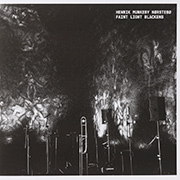 Henrik Munkeby Nørstebø: Faint Light Blackens [Psychic Liberation]. Less of a performance and more of a piece from Nørstebø this time, compared to his 2023 release Dystopian Dancing. Paradoxically, this work in seven acts was “produced in a long form performance gesture, with no overdubs” or post-production (recoding dates are given as 10 and 11 October, so maybe it was an allnighter). Nørstebø’s instrument is the trombone, which he seems to use as a means to produce sound as much as he uses it as a brush to deploy those sounds where needed. The thirty-five minute piece maintains its coherence by brooding, essentially; the sounds are remote and fittingly sepulchral throughout. While focusing on shape and texture, maintained through a palette of intaglio greys, there are just enough inflections of colour and flashes of repressed activity (trombone is a recondite medium for noise music) to elevate the whole thing above po-faced complacency.
 Jashiin: Overflow [mainly slow organ music]. Like it says on the label, Huw Morgan is the master of mainly slow organ music, as heard in his many recitals, mostly in the west of England. Jashiin is a composer based in Istanbul; he describes Overflow as “a moment of charged calm, held for as long as I could manage to hold it”. So, long stretches of suspended chords transitioning from one to another and all the acoustic and psychoacoustic effects this can evoke, if done right. Morgan does it right, of course. Jashiin leaves matters of registration and dynamics largely up to the performer, so Morgan presents three interpretations of the piece: the first rich and full, with range and depth, the second all reeds and strings, creating clashing harmonics and beating overtones, the third soft and disembodied, floating in darkness.
Filed under: Music, Reviews by Ben.H
Tags: Henrik Munkeby Nørstebø, Jashiin
No Comments »
Soundscape Summer
Sunday 9 August 2026
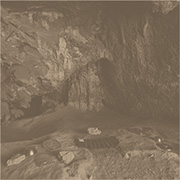
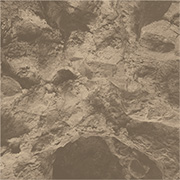 Manja Ristić: lights shimmered like whispers in the depths of the trees; Miska Lamberg: stillness in their isolation; Dylan Kerr: Pas de la Demi-Lune; Michael Pisaro-Liu: anabasis (1) [Sawyer Spaces]. Sawyer Spaces is a sub-label of Sawyer Editions, focused on soundscapes, pretty much: their albums are either field recordings, or make use of field recordings, or are otherwise defined by the particular location in which they were created or recorded. Ristić presents a pair of montages, made up of recordings made around Portugal, Austria and Croatia. There’s a lot of autobiographical and genealogical subtext behind both pieces, but Ristić seeks to convey the meaning through ambience without resorting to allusion or narrative. The open-air sounds are deep and nuanced without being overtly suggestive, which also lets you work out for yourself that you’re hearing a composition and not raw documentation; you feel validated when the instrumental sounds appear. The thing about ambience is that you really need to be in the place itself to be certain you truly feel anything that place has to tell you. With music, the best you can do is take it on trust and sympathise with whatever the musician is trying to convey. Also, any time I heard cicadas I assume it’s a reference to Presque rien. The Lamberg also presents two pieces, or one piece in two movements. The sounds are those of urban ambient hum, the constant nagging drone of traffic and air conditioning (If only! gasps the European audience). Both tracks generate a negative presence through layered industrialised white noise, not pleasant but not actively unpleasant, just intrusive. Lamberg recommends playing it soft (I didn’t) so it presumably works as a compounding, or confounding effect on the noise you’re already dealing with, but I’m not sure if the intended effect is amelioration or alienation. I played both these albums on a sunny afternoon and dozed off to both.
Kerr’s Pas de la Demi-Lune is a different deal; composed for a performance in a cave, and recorded here in a performance in a different cave, this is a straight-up musical piece, albeit one entirely shaped by environment. Kerr plays computer-generated sine tones that build up high, complex harmonics by following lattice processes devised by James Tenney. Transducers are attached to metal bowls and trays, causing them to vibrate and rattle sympathetically with the sine tones. Organ pipes are blown, selected and tuned to the frequencies created from the harmonies generated by the sine tone processes. It’s a rough-sounding work, suitably harsh and craggy for the landscape in which it was created, with interference patterns cutting across organ and sines and bolstered by agitated metalwork. Not the easiest of listening nor the most lucid of sonic phenomena, suggestive of the way nature conceals more than displays the principles upon which it operates. Evocations of rituals aside, what is interesting is the way Kerr uses his methods as a sort of armature for nature, with his instruments acting as a representation of the natural surfaces and features, without the need for analogies.
anabasis (1) was composed by Pisaro-Liu in 2013; this performance was made in London in 2024. It’s a sectional score – 72 parts – for five musicians using materials assigned to four categories: sand, wind, tone and wave. The musicians here (I recognise James Creed and Mia Windsor) use a prepared reed organ, electromagnetic pick-ups, pedals, a fan, microphones, a giant sail, digital processing, various objects and, of course, sand. Is this site-specific? I suppose it is. On the first listen it sounded like documentation of a rather busy performance which you probably needed to be an audience member, if not a performer, to fully appreciate. It’s all a bit wild and woolly, with no conceptual elegance immediately observable as in some other Pisaro-Liu pieces. This can be a strength or a weakness in performance, depending on the musicians, the venue, your mood. The second time I heard it, something clicked. The busyness meant that things kept happening over its 72-minute duration; you’d think you had a feel for how the piece was progressing and then it suddenly takes off in a new direction. The second time, every new angle or development sounded fresh and spontaneous. The second time, I wondered how they were all coming up with so many sounds. The second time, I forgot that it was recorded indoors.
Filed under: Music, Reviews by Ben.H
Tags: Dylan Kerr, Manja Ristić, Michael Pisaro-Liu, Miska Lamberg
No Comments »
Electronic Noise Shootout, Summer 2026
Sunday 12 July 2026
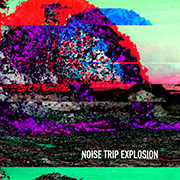 Nolan Hildebrand: Noise Trip Explosion [Redshift]. The five compositions presented here sound like pure anarchy, so I like it; they seem to just happen rather than follow any organisation or pattern, which is good. They’re all electroacoustic works, so Hildebrand – working with liver mixer feedback, data-generated noise and interactive electronics – and his acoustic musicians are all to be commended for the unbridled anal expulsiveness they display as they whip up one huge sonic mess after another. There’s a perverse glee to their noisemaking as they try to be as grating, abrasive and hyperactive as possible and the pleasure is infectious, in a way that is so often promised by the hip kids but seldom delivered. Hildebrand as a composer appears to see his task as goading the musicians into fresh extremes as much as setting any parameters or restraints for them. For nearly an hour, nothing pauses for breath or takes so much as a moment to look back on what havoc has been wrought, it just relentlessly plunges forward at full tilt. It’s exhausting, but in a satisfying way, and yes you will listen all the way through. Strike another blow against the myth of Canadians being polite.
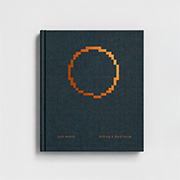 Josh Mason: Kicking A Dark Horse [Greyfade]. The latest in Greyfade’s folio series, which combines an album with a hardcover book. The nine tracks were composed on modular synthesizers fed into digital data processors, exploiting the mismatches between the two systems to create distortions, errors and discrepancies (see cover art). The book is a free-form, fragmentary collage of poetry and diary that makes for “a nonlinear travelogue of the states [sic] of Florida”. The two are intended to form an emergent artwork, each illuminating the other – discontinuity something something simulacra etc. – which will take more time to see how it pans out, so I’ll focus on the music. Warm analogue sounds warped by electronic artefacts, with a cool ambient vibe throughout. Old heads will immediately hark back to the fin de siècle avatars of Oval and Pole, and this music seems to combine the sound of both: nervous stutters and crackling tension over an impassive surface. Mason comes by this sound honestly, detailing how it’s the result of working with unfamiliar and recalcitrant equipment to achieve a serendipitous travesty. He keeps the drama implicit, anticipated rather than felt, which enhances the wary mood maintained throughout. They’re evocative but ambiguous landscapes, or rather, keeping with the concept and the fin de siècle fashion, a soundtrack to the book.
 Hunter Brown: Stoppages Vol. 3 [Party Perfect!!!]. I was all stoked about Brown’s Stoppages Vol. 1 [∞] and then skipped Vol. 2, so here’s me getting stoked all over again over Vol. 3. Like I said last time, Brown takes a David Tudor-like approach to glitch, interrogating the principle upon which the digital error operates and then applying it as a compositional method. The effect is transcendent. On this outing, he exploits the noise floor algorithms used in audio systems to distinguish signal from background noise; by reducing the audio level until it merges with the background, the system merges the two into a hybrid data bit. The results then have to be cranked up again to make them audible. For source material, Hunt subjects tracks from the two previous volumes to this process, creating pieces somewhere between variation and trope. It’s less immediate in brute force than Vol. 1, but more complex and sophisticated in its intricate sounds while equally rigorous in its conception and execution, with a concomitant inscrutable logic in structure and form. Why didn’t I mention Vol. 2 until now? Because I lost my copy. Guess I’ll have to go get it again.
 Laurent Güdel: State Music [Insub]. There’s a book with this one, too. Güdel has toured the venerable bastions of electronic music – EMS Stockholm, Columbia University, etc. – and produced a disquisition on the relationships between cultural and political power located inside 20th Century institutions dedicated to music research. It’s an exercise in poking through the leftovers of history, with the six pieces presented here composed on location on vintage Buchlas, Serges and EMS Synthis. The essay follows suit, raking over the past with an (ironically, academically popular) ethnocentric assumption that the Cold War was created in a vacuum and fought entirely on one side. It’s light on the pseudo-Marxist analysis and more of a verbal conspiracy board, using vague syntax to assert a link between synthesisers and fascism, eugenics and other maladies including, inevitably, the Jewish Menace. With chapter titles like “Vladimir Ussachevsky: Agent and Target of US Imperialism” it recalls pleasant memories of the shitkicking the American avant-garde got up to in the 70s with varying degrees of earnestness. The music? It’s strange, and for the most part unlikeable, possibly by design. Each piece gathers a wide array of timbres, textures and effects and throws them together one after another as though Güdel is impatient or dissatisfied, making each piece sound more like a demonstration reel for the instrument than actual music. The exception is the last piece, made on the non-functional RCA Mark II synthesizer, which Güdel uses as a resonator, antenna and resistor to transform field recordings and ambient sound. It’s a transformative work which shows creativity and insight into the relationship between sound and technology in a way that is not evident in the preceding tracks.
Filed under: Music, Reviews by Ben.H
Tags: Hunter Brown, Josh Mason, Laurent Güdel, Nolan Hildebrand
No Comments »
Troubled Quiescence
Sunday 5 July 2026
 Conner Simmons: any sense of where we were gone [Sawyer Editions]. A floaty, mild-tempered expanse of soft – but not always gentle – sounds; curiously, the free-form feeling gains from being sorted into a modular structure of five compositions: two string quartets to open and close, with a larger central work for unspecified instruments, which in this case is a larger ensemble including voice. The three pieces are unified into a single work by two short interludes for bowed prepared piano, composed a year later but also apparently heard as a whole from the first performance, which is the recording presented here. There are fairly subtle electronic treatments throughout, designed to emphasise lingering tones and after-images. The outer quartets are marked by a lack of movement, with most of the changes coming from a small amount of harmonic expansion and some ramping of dynamics. In the central piece, titled explain it to itself as wind, the improvisation allowed to the musicians emerges slowly, tentatively, each producing sounds individually that take care not to coalesce into a single image, for listening in the moment as opposed to coming away with a clear impression. Simmons alludes to all the pieces drawing upon “postmodern fiction, obscure geometry textbooks, and poems about time” and quotes from Cortazar’s Hopscotch; in short, it’s a synthesis, albeit one that steers clear of Delibes and Saint-Saëns, not to mention Rose Bob and Alix Alix.
 Wilson Tanner Smith: Perpetual Guest [Sawyer Editions]. Reflective solos on a harmonium, interspersed with some cello. The mood of cautious tranquility prevails throughout and Smith plays with simple, homespun diction. It’s the sort of thing we’re all sure we’ve heard somewhere before, not least because the music originates from a site-specific basis: “created in the abandoned Kreenholm Textile Factory complex on an island in the middle of the Narva River in Narva, Estonia, a stone’s throw from the Estonian-Russian border.” It’s the cosiest form of exoticism, with a hint of potential danger and sometimes with this kind of situational art it seems that one is hoping the situational pathos magically substantiates itself in the music – a form of implicit hauntology through psychogeography. None of that really matters though, as Smith’s approach to making music here is direct and unconcerned with intellectual justification. As such, the familiarity of it all locates this music securely within a nascent tradition of site-specific improv, where the practice and the craft take precedence over cleverness or subversion. Most importantly, Smith found the antique harmonium and restored it to working order himself, so it’s a perfect example of site-specific music and he’s earned the right to play whatever he damn well likes on it. Just as well his playing is studious and pretty.
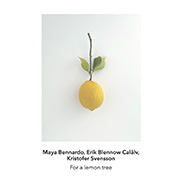 Maya Bennardo, Erik Blennow Calälv, Kristofer Svensson: For a Lemon Tree [Another Timbre]. You may remember Bennardo and Svensson teaming up with percussionist Etienne Nillesen for Improvisation on Āsthita, January 2, 2024. This time around, we hear Improvisation on Prakāśa, June 10, 2024, with Calälv on bass clarinet replacing Nillesen on drum; Bennardo and Svensson continue respectively as before on violin and kacapi (I looked it up, it’s a Javanese zither). Svensson has devised the distinct tunings used in each of these improvisation, on this occastion using 11-limit just intonation, a scheme that stretches outside the bounds of what Western ears would normally consider as “in tune”. The improvisers are set rules on what modes to play within the scale and an overall shape but are otherwise free to play as they wish. As with the earlier improvisation on Āsthita, its companion piece, the trio play within the mode more than upon it, but there are differences. The greater range and sustain of Calälv’s clarinet allows him to form the harmonic backbone of the piece, using the lower registers sparingly. Svensson’s muted zither plucks out tropes on the clarinet’s long tones, sometimes leading, other times elaborating, while Bennardo threads a translucent harmonic layer between the two. It sounds wonderfully composed, in either sense of the word, with each displaying an instinct for when to remain silent, giving the music greater definition beyond an ornate drone. To illustrate the point, the album begins with For a Lemon Tree, which is a distillation of their acquired technique into a formal composition.
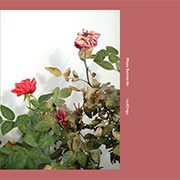 Maya Bennardo: rustlings [elsewhere]. The title could be a self-deprecating description of Bennardo’s style of playing, where she nudges her violin to the threshold of breaking up its tone into pure, whispering friction. Her two compositions here make use of this breathy style of bowing as a means of formal development, rising and falling between sounds that are nearly full of their pitch, to almost empty. The 23-minute dormant gardens i. is for violin and viola, played by the duo andPlay (Bennardo and Hannah Levinson). It resembles a horizon line cast with shadows in low sunlight, drawn freehand and rendered in long, feathered strokes. Small amounts of colouration and harmonising play over what strikes the listener as a single pitch which wavers and shimmers, establishing its presence through an apparent immobility that emerges through the constant microscopic activity. The work’s duration opens up the scale of this activity fom miniature to landscape, giving the small sounds greater seriousness. The 27-minute summer rustlings is Bennardo solo, the relatively dry acoustics exposing how little adornment there is to her playing other than through the sounds arising from within the instrument when subhected to her technique. On the microcosmic scale, there is plenty of technique to be heard. The piece falls into three sections with a coda: in the first she draws a line firm but pale, adding flecks of plucked strings to the constant, fragile bowing, figure and ground in the lowest possible relief. The second slowly breathes pitch into frail harmonics, nuilding up into fast arpeggios of high notes, still half whispered. The third is a long monophonic drone that then starts to generate a kind of internal polyphony out of the timbral changes in bowing technique, like a doubled voice. The coda is disarmingly simple. It’s a virtuosic work which impresses without feats of pyrotechnics or endurance.
Filed under: Music, Reviews by Ben.H
Tags: Conner Simmons, Erik Blennow Calälv, Kristofer Svensson, Maya Bennardo, Wilson Tanner Smith
1 Comment »
Back to work: Morgan Evans-Weiler & J.P.A. Falzone
Tuesday 30 June 2026
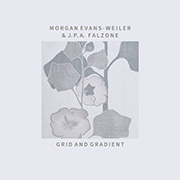
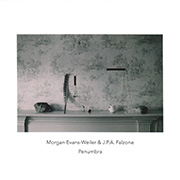
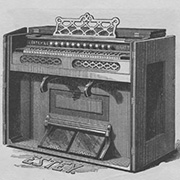 Morgan Evans-Weiler: Grid and Gradient [Kuyin]. Morgan Evans-Weiler & J.P.A. Falzone: Penumbra [Another Timbre]. J.P.A. Falzone and Morgan Evans-Weiler: Ascending Music [Sawyer Editions]. Can’t believe I haven’t yet written anything about the collaborations by Morgan Evans-Weiler & J.P.A. Falzone, two musicians and composers who make a virtue out of abstemiousness and rigour. I was going to say simplicity, but there’s nothing particularly simple in the way the two of them do much with little. Evans-Weiler plays violin, as sparingly as possible; Falzone plays keyboards. In Penumbra, recorded in 2024, the prepared piano takes the foreground, augemnted on occasion by celesta. For each of the four pieces, Falzone establishes a reticent, contemplative mood, picking out notes gently while leaving plenty of space for Evans-Weiler to add the faintest colouration, wisps of bowed violin or an occasional low, electronic hum. On Ascending Music, the keyboard is a reed organ, recorded in a stairwell for additional reverberation. The textures are therefore more homogenous, playing out as a set of chorales in light, sustained tones. Both musicians’s playing may sound quite a bit freer than on Penumbra, but their meticulous approach is apparent through the delicate changes in colouration they both achieve in each piece, emphasising the style of musical mindfulness they used to record each of the five pieces here. The opening and closing title works on the album are credited jointly: they do more than just ascend, but there is greater pitch movement in these two works, with Falzone using electronics and slide whistle to pair off against Evans-Weiler’s slow glissandi. The three middle tracks are by Falzone, using cycling permutations of pitches with close attention to intonation and reflecting upon the resonant frequencies of the recording space. 22nd Century Music is a short work referencing Joseph Kurdika referencing Laurence Crane.
The new album on Kuyin is Grid and Gradient, an open-score composition by Evans-Weiler performed by the duo on violin, quarter-tone pianos and celesta with electronics. Besides the microtones, this comes across as a more developed performance by the two – more complex in thought, though not in surface activity. Bearing a superficial resemblance at first to Penumbra, both musicians play in an equally restrained manner, the violin’s presence still discreet but more of a counterpart to the pianos. It’s a long work that falls into six stages, each working within a different set of musical conditions, leaving the performers to find their way in maintaining the atmosphere. The methods and the processes are more obscure than before, but this allows for a greater depth of expression in the music, even as its substance remains elusive. The impression it makes is susceptible to small but profound changes, much like the rare introduction of unexpected sounds that open up new perspectives on what you’ve just heard.
Filed under: Music, Reviews by Ben.H
Tags: James Falzone, Morgan Evans-Weiler
No Comments »
Electric Guitar: Jon Catler, Cristiàn Alvear
Sunday 7 June 2026
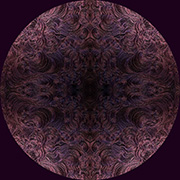 Jon Catler: The Young Mountain of the East [Chaikin]. If the title doesn’t tip you off, the Jung Hee Choi cover art will: this is an homage to La Monte Young. Catler is a veteran of Young’s Forever Bad Blues Band and Choi’s own Sundara All Star Band, with a long history of playing microtonal electric guitar across a range of genres. As an homage, The Young Mountain of the East is a well-informed and constructive extension of Young’s legacy, more than any derivative or sound-alike “tribute”. Catler takes the opening chord of Young’s The Well-Tuned Piano and builds upon it, extending the paired intervals beyond Young’s imposed limit om harmonic complexity into even finer gradations (to get technical and quantitative, Young’s composition sticks with pitches relatable to the first seven harmonic overtones – Catler’s goes as far as thirteen). Written as a double quartet for overdubbed fretless guitars, Catler produces rich but translucent sonorities made of e-bowed strings in esoteric tuning. The generated harmonies of the chords are very tasty, with the signature sound being the use of sliding tones to resolve from one set of intervals to another. The piece is organised into twelve sections, each of precisely equal length, suggesting the formal rigor beneath the music’s superstructure. While there is a logic to the piece as it progresses from one set of intervals to the next, it also allows development and further apparent flexibility to emerge as a consequence of the process – from one section to the next things get more complex, until reversing and resolving back to the initial stability of the opening section. Catler uses the complexity to extrapolate rhythms out of the beating frequencies in the centre of the piece, breaking the prevailing gloss of the sustainer guitars, and even cuts loose a little with some melismatic soloing before stability reasserts itself. It’s a different beast from Young’s own works, as you would hope, while sharing some of the same qualities: interrogative study, self-discipline, a devotional approach to expression, an immaculate surface. It does not, however, make demands on the listener’s endurance.
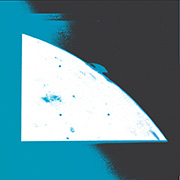 Cristiàn Alvear: Sin título #30 – Singularidad #1 (Carrasco – Astaburuaga) [Insub]. Alvear is a guitarist who brings a necessary attitude somewhere between patience and bloody-mindedness to pull off pieces composed out of the slenderest means with an absolute rigor and austerity. He makes each of these works inexorable and inevitable, without ever seeming machine-like about it. The composers here for these two solo works are Nicolás Carrasco Santiago Astaburuaga, both of whom I’ve heard Alvear play before. Each piece sounds either antecedent or precedent to the respective previously recorded work. Carrasco’s previously heard sin título #26 is a study in stasis, as is this sin título #30. Over half an hour, Alvear begins by ringing the changes on harmonics and then settles into a repeated, chiming chord. In terms of form, it’s the skeleton of a James Brown jam slowed down about ten times, staying on it until over halfway through when the harmonics briefly come back before resuming as before. Well, not quite as before, as the chiming chord is now a single low note that broods at length before suddenly cutting out. Astaburuaga’s Singularidad #1 is about half as long but works on a similar scale. As with the Carrasco, it’s a puzzling, oblique non-sequitur of a piece, beginning with Alvear slowly picking out a loose, repeating riff disturbed by occasional off-kilter bursts of electronic chaff. A field recording interrupts, leaving us with some audio verité while the guitar grumbles with bass reverberations until it eventually rebuilds into a slow, indecisive vamp. A few other intrusions occur before everything just breaks off. As observed last time, “Time passes in a dreamlike state, with no logical connection or momentum, and so will either soothe, frustrate or disturb you.”
Filed under: Music, Reviews by Ben.H
Tags: Jon Catler, Nicolás Carrasco, Santiago Astaburuaga
No Comments »
Music We’d Like To Hear (again): Eldritch Priest, Jürg Frey
Sunday 31 May 2026
A “mongrel array” of musicians were conducted by Jack Sheen in a performance of Eldritch Priest’s pleasure drenching… last Thursday. The piece was written in 2003 and this was its second(?) airing. The difficulty comes from several sources: its instrumentation (electric guitar, lap steel guitar, organ, piano, clarinet, harmonium, assorted strings, percussion and bass), its length (about ninety minutes) and its scoring (combining notation of various precision and suggestion). The angular melodies and lopsided meters heard in other Eldritch Priest works are present, but smoothed out into a sort of dissolute lounge jazz that moons about as though to fill up time before something else happens. The lap steel, organs and vibraphone add an oily sheen to the smoothness and insinuate a sinister aspect lurking in the background. A demotic drum kit of cymbal mounted on snare erratically rapped out the absence of a consistent beat. Everyone seems to drift in their own reverie, more or less together. There are pauses, then everything resumes apparently much as before. And so, questions of orientation, direction, structure and form steadily become irrelevant, replaced by a simple sense of scale. As the music drifts, so does it gradually drift apart. The suggestion of an ominous presence occasionally rears back into consciousness – a sudden snare strike, a louder chord – but the foreboding imprints itself more through absence, as the established elements drop away, not always to return. For much of the time it’s all ensemble playing, before breaking out into smaller groupings; but once that has happened the full ensemble never really seems to return. Solos become precarious. At one point the music dwindles away to a lo-fi recording played into a mute room of musicians. The cymbal finally stops but then you wonder why it never comes back. More and more, your attention comes to what is missing. Chatting to someone afterwards, he described it as hearing smooth jazz slowly bleed out. The overall character of haunted loucheness was expertly conveyed by the ensemble, an expanded form of Apartment House, including Sam Cave on guitar and EP himself on the lap steel, which had the last word. I do hope someone can get together a good recording of this piece, sooner rather than later.
The following night had the UK premiere and second performance of Jürg Frey’s Clarinet Quintet, played by the same musicians as in the first peformance last week on Bologna and in the recording. I won’t add much to what I’ve already said, except to comment on the difference between hearing a recording and hearing it live. For the recording I wrote “I suspect the listener’s responses to it will alter a little each time it is heard”, which will obviously be the case when hearing a live performance, but this time I picked up more on the aspects of Frey’s earlier styles that have been retained in his new work, such as when the quintet gives way to the viola plucking a single note, lingering over this moment before moving on. There was also the more general difference in that in a recording you listen for what has happened, but when live you listen for what will happen. The different anticipatory sense drew attention to what seemed a slightly more hesitant opening to how the piece was played, which made the Apartment House quintet’s interpretation on the night seem more fragile and their accomplishment more earned than taken for granted, with the piece’s strength to be found in the course of its performance rather than assumed from the start.
Filed under: Music, Reviews by Ben.H
Tags: Eldritch Priest, Jürg Frey
No Comments »
Michael Finnissy And The Guitar
Tuesday 26 May 2026
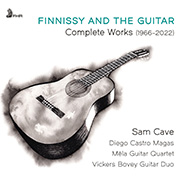 Michael Finnissy: Finnissy And The Guitar [First Hand]. “For this year, the usually anniversary-happy Proms have programmed sweet F. A.” I wrote this ten years ago as a passing comment on Michael Finnissy turning seventy. Now he’s eighty, the Proms has again conspicuously ignored him; I’m not sure if that matters for the Proms, any more. Meanwhile, some new albums have been coming out, with Métier adding another hefty volume of piano works adroitly tackled by Ian Pace (includes English Country Tunes) and a complete collection of his organ works, played by Forrest Eimold. The latter is a less-known facet of Finnissy’s work, as are the works for guitar. Finnissy And The Guitar: Complete Works 1966-2022 is an especially rewarding compendium both for bringing these works to light and for displaying the great clarity in Finnissy’s compositional voice; a voice that once acquired a reputation for speaking a recondite language. This may be down to the eclecticism of his style, which mixes a feeling for the more abstract harmony and counterpoint of 20th-century Europeans (and so looked at askance in Britain) with references to the musics of other times and places. He combines these tendencies intuitively, with a traditionally English empiricism.
The earliest work dates back to when Finnissy was about twenty: Two Cut-Ups of Three Fantasias by Alonso Mudarra makes free use of William Burroughs’ cut-up technique to collage fragments from the 16th-century composer, creating a pair of studies which explore polyphonic implications within an “economy of gesture”. It’s a youthful work so it can be called ‘limpid’, favouring construction over direction to make two pieces which are immediate but obscure, opening up a new way to hear how sounds fit together. It also captures the tone of ambiguous melancholy that permeates many of Burroughs’ collages. This is a first recording, made by Sam Cave, who also unearthed the piece while compiling this collection; he’s done a superb job in conception and execution. Cave plays four of the seven pieces here, the others played by guitarists closely associated with the music; all but one have not perviously been recorded commercially, if at all.
In the Two Cut-Ups any continuity is of course self-constructed, and the subsequent works carry over a sense of continuity that is friable, illusory or complicated to varying degrees. Felix namque, a compact work from 2012, carries over traces reminiscent of baroque lute and Spanish folk but metamorphoses between different expressions of one or the other, with sudden schisms and an abrupt end. The more elaborate but perhaps less refined Song 17 from 1976 contrasts flourishes of more esoteric language with moments of stillness and quiet, extended tremoloes. Cave takes those tremoloes to the threshold of hearing; his playing beautifully conveys Finnissy’s affection for the instrument, interpreting the music in a deceptively simple way, appearing not to take on a false persona for each piece or assume a burden of emotional strain on behalf of the avant-garde. (This is a more nuanced way of saying he makes it sound easy.) More particularly, Cave and the other musicians empathise with Finnissy’s observation that “one can become intoxicated with the sound, and forget about continuity and structuring”, giving attention to each moment while securing its place in the overall construction. Finnissy’s writing for guitar always makes time for the ear to linger on sensual details, even in the protean monologue of Nasiye (1982), played with pointed momentum by Diego Castro Magas. It’s a piece which creates its own shape out of attempting to reconcile, or at least find balance between, its inconguities, without ever resorting to easy despair. The duo Normal Deviates (2017), played by Daniel Bovey and Julian Vickers, who commissioned it, is even more of a headlong rush, with the two guitars locked in heated dialogue that alternately meshes and clashes. It’s complex, but never rushed to the point it feels like trivial scurrying; the Vickers Bovey Duo brings out its eloquence. Bovey also commissioned the guitar quartet Albion on the Road to Hell in 2019: played by him with the Mela Guitar Quartet, it begins as a shocking study in brutal timbre with all four musicians ferociously plucking out a series of repeated chords in unison. After finally exhausting itself, the piece slowly rebuilds from quiescence into a hazy miasma of mingled voices. The final work is the most recent and the longest, with Cave playing Outcast, a piece started during the Covid pandemic and finished in 2022. Both the most variegated and the most introspective in mood, Outcast is a musical transcription of sorts, or a translation, of the 9th-century Welsh poem Claf Abercuawg and so is in form another monologue. Cave imbues the work with tenderness, even in it’s bleakest moments and violent outbursts. It’s a pleasure to learn this music is now not so overlooked.
Filed under: Music, Reviews by Ben.H
Tags: Michael Finnissy
No Comments »
Not quite there: Stepančić, McIntosh
Sunday 24 May 2026
 Teodora Stepančić: Transparent Duo [Cloudchamber Recordings]. I dismissed Stepančić’s O A | F G as “precious”, accusing it of “silences, hushed tones, reverential playing and exquisite delicacy”. Transparent Duo reveals her bravado and commitment to this seemingly unrewarding aesthetic by producing a work of forbidding harshness and austerity, even as it is almost imperceptible. Composed for two string instruments with field recordings and written on transparent paper, the score’s pages either indicate towards a direction and length of glissando, or otherwise towards bowing style. The two sets of instructions may therefore combine to form an ephemeral but definite structure and substance. The realisation here is for two cellos, played by the n/ether duo of Laura Cetilia and Hannah Soren, heard recently in Cetilia’s own soil + stone. If you expect this combination to produce a warmer, fuller sound than the meagre materials suggest, you will be disappointed: Stepančić’s score admits that the glissandi played will be “mostly inaudible”. What is heard is whatever seeps through, however faintly, almost by accident; tentative silences open up and then persist, and as they do so become harder to dispel. The sounds lightly scratch upon the ear, as though carried by wind. This sensation is matched by the interludes of field recordings, open air with distant rural sounds. It’s all incredibly sparse, but it is not precious; it’s saved by the heiratic formality that arises from the piece’s conception, where raw but unconfronting sounds are studiously interspersed with silence, human and natural sounds separated, all arranged through impersonal, non-hierarchical means. The two cellists of n/ether exemplify concentration and seriousness of purpose in the extreme reticence with which their playing may be heard; as though to hammer the point home, the unyielding strictness of this realisation produces what sounds like a recapitulation at end.
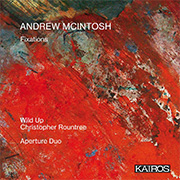 Andrew McIntosh: Fixations [Kairos]. McIntosh, who composed A Moonbeam Is Just A Filtered Sunbeam and who we recently heard as violist on Ian Power’s Brace and various bits of Jürg Frey, returns with three compositions for strings, without electronic processing, extended techniques or field recordings. The strings are retuned throughout, in just intonation. Besides the inherent resonances of the tuning McIntosh makes the perceptual tension, between our brains hearing it wrong while our ears hear it right, integral to the fabric of his music. The title work, a thirty-minute string octet, alternates between brief melodic passages on individual instruments with passages of stillness where a couple of harmonies float back and forth irresolutely. They act on the piece’s supposed momentum as though time were suspended, but that suspension of time and lack of movement becomes the subject. As observed in Moonbeam, “either the time is filled with greater complexities of tone and colour, or even less happens than before, depending on the attitude you take while listening”; Fixations has a more defined structure and as such those complexities arising from apparent insensibility become the focus of attention, more than the moments of activity. In other words, these pieces have a curious effect on the listener, being indisctinct but tough. The musicians are an ensemble called Wild Up, including McIntosh himself on viola and Erika Duke-Kirkpatrick on cello. Duo for viola and cello, with any number of violins features the duo tracing out faint patterns against an even fainter halo of the higher strings in shallow relief. All play in a similar range, rising up gradually until the soloists reach harmonics. The patterning is vague and subtle enough to make you forget the notes as such and remember only the translucent timbre of the work, until a sudden flourish of rapid, elegant arpeggios towards the end. The opening track is a brief amuse-oreille titled 434.6, played by the Aperture Duo of Adrianne Pope on violin and Linnea Powell on viola. A small secret is revealed here, as to how McIntosh uses his melodic material: the phrases are blunt and even simplistic, but played with great delicacy and refinement. To keep things suitably oblique, the booklet doesn’t contain notes on each work but a transcript between McIntosh and Cassandra Miller, which begins with the former questioning the latter.