Patricia Alessandrini and Marco Fusi: Proximity, Distance [Sideband]. I’m all about using feedback as a musical method, so I’ve been getting to grips with viola d’amore adept Marco Fusi‘s collaboration with Patricia Alessandrini. Alessandrini works with acoustic feedback and electronics, and has spent about the last five years on and off creating with Fusi an elaborate but lucid style of electroacoustic music. The two musicians’ respective instruments form a symbiotic relationship, with Fusi’s violin and viola d’amore acting both as resonant bodies and tone generators, each playing roles which can simultaneously generate and condition the feedback conditions in real time. Alessandrini makes use of amplification, including contact microphones, and the resonance of the recording space to introduce the feedback tones through the speakers. She has also built the “Feedbox”, a collapsible, portable wooden container with transducers fitted to it to act as a surrogate loudspeaker, large viol and small room all at once. Fusi and Alessandrini work together very closely, with a degree of interaction that shows up much live electroacoustic music as little more than a form of accompaniment. The thinking here is beyond instruments-plus-electronic processing, instead harnessing electroacoustic phenomena to create a mercurial compound instrument with a life of its own. The opening piece “Adjoining, Touched” shows this best, in that you quickly give up trying to distinguish one musician from the other as it misses the point. Each of the pieces maintains a serious mood for the album, even as the colour and shading is far from monochromatic; the focus is on producing varieties of tone. On “Squared, Boxed” percussive effects are introduced, either from the Feedbox or one of Fusi’s instruments magnified by amplification (both violin and viola d’amore are used throughout, with one often present passively as an additional resonator). In the later pieces some more obvious bowed and plucked sounds seem to emerge, but these are used as a means to an end, or as another coloration device to the overall sound: the title piece “Proximity, Distance” sounds like an ensemble transformed, while on “Fractured, Undone” the strings seem to function as triggers for different kinds of feedback oscillation. It’s a rare case of an album focused on demonstrating innovative techniques that both succeeds as a musical experience and wordlessly reveals a depth of insights into the ramifications of pursuing this technique. It also makes me sad that I won’t be able to get to Fusi’s solo gig in London this week.
 Laura Cetilia: gorgeous nothings [elsewhere]. It can’t be just me who’s thinking there’s been an awful lot of albums in recent years by female cellists who also sing a bit. Not quite as prevalent as solo albums by crossover-type composer-pianists, but still. This is why I initially balked at an album by just such a cellist with the title gorgeous nothings. Forgive me, I forgot she’s also a member of the ensemble Ordinary Affects, whom I’ve heard giving fine interpretations of works by Mangnus Granberg and Michael Pisaro-Liu. Her three works on this album are spare, thoughtful pieces: the title work is indeed for solo singing cellist, but the nothings alluded to are more John Cage than Taylor Swift. It’s a calm, sombre affair: bowed notes are slow, soft and translucent, but within a low, restricted range and in no mood to float. Cetilia’s voice provides harmonic overtones that resonate with or beat against the cello playing. I’d call it melancholy, but then the second piece is titled six melancholies, with Cetilia joined by fellow Ordinary Affects members Morgan Evans-Weiler on violin and J.P.A. Falzone on vibraphone; the percussion is often bowed, acting in a similar manner to Cetilia’s singing in the previous piece. It’s an introspective, self-effacing work, the three performers studying each note, chord or short phrase in isolation, treating each event with close attention before moving to the next. The longer piece soil + stone is a cello duet with Hannah Soren, Cetilia again adding voice very unobtrusively, as coloration and troubling the certainty of the cellos’ pitch. It’s not a heavy piece, neither a drone nor a drag, but it does not deal in trifling lyricism. The two cellists ground themselves with slow descending passages, taking the harder road. The gentle beauty that emerges from their playing comes through as a reward for their efforts, rather than assumed as a premise.
Filed under: Music, Reviews by Ben.H
Tags: Laura Cetilia, Marco Fusi, Patricia Alessandrini
No Comments »
Vestiges of tonality: Joseph Branciforte & Jozef Dumoulin, opt out
Thursday 19 March 2026
 Joseph Branciforte & Jozef Dumoulin: Iterae [Greyfade]. With its slightly fuzzy chimelike sounds and reverb, the electric piano (particularly the Fender Rhodes variety) has always struck me as a dreamlike instrument, always somewhat aloof from its context. It hadn’t occurred to me that there might be musicians who work with mutations of these instruments, but that’s just what Joseph Branciforte and Jozef Dumoulin have been doing independently for some time. Iterae puts the two of them together in a two-day recording session of manipulated improvisations. Their respective Rhodeses are treated electronically, both in their sounds and in how their playing is restructured, with real-time editing guiding how the unfolding music is shaped. With the use of distortion and filtering, the small amplified sounds of a Rhodes piano quickly lose their resemblance to the conventional instrument. The live editing consists of loops and processes that mimic tape delays, with elements repeating while being slowly transformed or effaced. Branciforte and Dumoulin thus make use of short gestures that provide both continuity and change, allowing large-scale developments to emerge out of small elements in near-stasis. The press release mentions “post-glitch” to save critics from having to risk it themselves, and indeed the album has the traits of that genre, including the association with ambient music. The emphasis is always on creating texture and atmosphere, with none on representing the improvisers’ chops, happy to explore one space without ever settling into a comfortable groove, then, little by little, events start to drift away from the familiar. Things start out hinting at melody and then gradually evolve into more complex atmospherics, but even in its crunchiest moments the musicians always retain suggestions of melody inherent in their instruments, without ever breaking into full-blown song or all-out noise. The two of them maintain this tenuous balance throughout, over four extended pieces that each fall into a two-movement form. That dreamlike quality is also present, in a shapeshifting, time-slowed-down way.
The blurb suggests the structure of the album is modular, by which they mean you can play the thing straight through as one large work or as four pairs of tracks. The physical media version emphasises this by packaging the set as five discs: one regular CD and five mini-CDs (remember them?). Vinyl collectors will be relieved to learn that the dust jacket comes with a wall-hanging tab already fixed to the back. It’s not out yet but they’re touring Europe right now.
 opt out: Geography_VII [Moonside Tapes]. The premise of this short album seemed intriguing from its brief blurb: pieces synthesised and sequenced in MaxMSP, built on some of Erv Wilson’s microtonal scales. Sadly it’s not so interesting to listen to. It isn’t a dour academic exercise, as many microtonal works can be, but the pieces are fairly rudimentary and don’t seem to particularly benefit from using Wilson’s tuning. Those two factors in tandem work to defeat the apparent purpose, producing a set of pieces with windchime-like repeating patterns with not much accompaniment or development, pleasant enough without demanding attention. The exception is the track “Presence_chamber”, which uses longer, strained notes with almost no melodic movement, making the astringent intervals themselves the musical subject and substance. It also reminded me that you can get Warren Burt’s classic Harmonic Colour Fields on Bandcamp.
Filed under: Music, Reviews by Ben.H
Tags: Joseph Branciforte, Jozef Dumoulin, opt out
No Comments »
Almost Nothing: Pisaro-Liu, Reinhard, Ullmann
Sunday 15 March 2026
 Michael Pisaro-Liu: Concentric Rings in Magnetic Levitation [Sawyer Editions]. Just last month I was carping that Fata Morgana, Pisaro-Liu’s collaboration with Niels Lyhne Løkkegaard, had both not enough and too much going on all at once, making for stultifying listening. This realisation of his 2011 composition, on the other hand, is the real stuff. It shows the profound difference between almost nothing and not enough, with much of the hour’s duration passing almost inaudibly. The near-silence is observed with intense concentration by the three musicians, and their concentration becomes infectious. The name of the ad hoc trio is Forming; they listen in to a cycle of almost imperceptible sine tones, articulating the presence of sound, if not always its manifestation. Andrew Weathers marks off tiny inflections with small piano notes, Ryan Seward’s cymbals augment the upper partials of the faintly humming air, Carl Ritger uses electronics and field recordings to compound the implicit hum that pervades the absence of activity. By the end of the hour, what had at first been inaudible has soaked into your consciousness, radiating sound. This recording captures a very special moment.
 Samuel Reinhard: For 10 Musicians [elsewhere]. I described Reinhard’s earlier piece For Piano and Shō as “tinting the backdrop of silence”. In For 10 Musicians the forces are larger but the music is even more intangible. Two pianists – Paul Jacob Fossum and Gintė Preisaitė – reiterate a single chord at their leisure, with some free interplay on a small gamut of single notes. They are circled by an ensemble of clarinets, violas, cello and double bass, who play as softly as possible at their discretion. There are faint developments that occur by chance, through small changes in colouration and harmony, keeping everything still but alive. The ensemble’s presence reminded me of the electronic treatments that shadow the solo pianist in Michael Pisaro-Liu’s Green Hour, Grey Future, but in Reinhard’s case the sound has greater depth and the form is more rigorous. There are four movements, each identical other than the pianos’ chord; as always, same but different, each resembling the other but cast under a different shade. It’s a large work which is always present but elusive, with the musicians and recording successfully transcending the music’s substance into the aether.
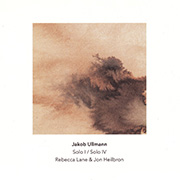 Jakob Ullmann: Solo I / Solo IV [Another Timbre]. Way back in 2013 at Huddersfield I heard the first (successful) performance of Jakob Ullmann’s Son Imaginaire III. It had a galvanising effect on me. “Again, a piece that hovered on the threshold of audibility, but in Ullmann’s case the music contained a faint but indelible richness, a mystery in how the sounds blended together in ways that couldn’t be understood, from one musician to the next and with ambient sounds in and outside St Paul’s Hall. Sitting there, attention focused on perceiving the music, you could lose yourself, your concentration on a sound so diffuse that your attention becomes a sort of dream state. Over a hundred years ago painters really started to pull apart the idea of what it meant to see something; we still don’t know what it means when we say we’ve heard something.” In a talk before the piece, Ullmann described his compositional methods, making use of a kind of palimpsest of overlaid pages. These translucencies partly reveal and partly obscure. In the Solo works, the musician accompanies themself with recordings of alternative interpretations, covering additional aspects of the suggestive score that cannot be realised in a single take. On top of this, pieces can also be played simultaneously. Rebecca Lane plays Solo I on quarter-tone flutes, Jon Heilbron double bass for Solo IV: both have a strong history and affinity for this type of sensitive handling of small sounds. Their combined performances produce superbly evocative sounds for compositions that expect the material to be kept at a level below perceptible, wide-ranging in timbre and register without ever seeming deliberate or intentional. Everything just seems to emerge and persist organically, creating an experience both indistinct and indelible.
Filed under: Music, Reviews by Ben.H
Tags: Jakob Ullmann, Michael Pisaro-Liu, Samuel Reinhard
No Comments »
Obstinacy
Saturday 28 February 2026
 Sachiko M: Sounds From M [Party Perfect!!!]. The latest two Party Perfect releases return to their abrasive and bloody-minded roots. I heard Sachiko M play live in Melbourne back in (checks sleeve notes for this album) 2001? Gosh. She had a sampler with nothing in the memory and somehow got the high-pitched sine wave that emerged from it to move about a bit, after a fashion. Since then, I have never actively kept tabs on her career but I had always hoped that she was still doing more or less the same thing, somehow. It is therefore a pleasure to say that Sounds From M proves the last twenty-five years have neither softened nor diluted her end-point aesthetic. The piece, recorded one day in 2024, falls into seven nested movements of precisely five minutes each, forming a kind of palindrome. A high-pitched sine wave pierces the air, ducking and diving depending on where your head is in relation to your speakers. Pulses of digital switching create pops and crackles at various frequencies; the sine wave returns, but higher pitched and out of phase, creating dead spots in your room. In the central section the sine wave pushes upwards against my threshhold of audibility, becoming frangible with more pulsing. Then it recapitulates on each action in reverse. Digital pops aside, it’s all mastered at a very low level. There’s a level of commitment here, beyond experimentation, to create sonic objects that evoke a physical presence while seeking an absolute minimum of texture and colour.
 Luciano Maggiore: tordo + uah + cick [Party Perfect!!!]. It’s Luciano Maggiore, so as is the custom I must admit I have no idea what is going on. This time, however, he is unwilling to help me, other than to say he composed and performed this piece a small number of times around Europe in 2024. I think there’s a sampler invovled here too, maybe with CD players, Walkmans, stuff like that. Track 1 was recorded live in London and has lots of low-level twittering and the occasional chirp on a farily regular basis. It goes for over half an hour so you know he’s committed and you’ll have to start paying attention sooner or later, but what that attention will get you is something never really answered. He’s confronting you but giving you the freedom to be unaffected by it; a rare commodity in modern art, to accommodate indifference. Maggiore makes insistent but neutral sounds, refuses to elaborate, then on track 2 goes and does it all over again in Berlin. Hilariously, the two sample extracts on the Bandcamp page are each thirty seconds long, because really anything more is superfluous. You can also get it on cassette, so that the low-level twittering is submerged in hiss.
Filed under: Music, Reviews by Ben.H
Tags: Luciano Maggiore, Sachiko M
No Comments »
Repetition and novelty
Saturday 21 February 2026
 Andrew Greenwald: for Distractfold [dFolds]. A couple of new interpretations of Andrew Greenwald pieces which have previously appeared on a Kairos CD, with a newer ensemble work. Greenwald credits Distractfold as being part of “the beginning of a metamorphosis in my composing” and this half-hour programme gives some insights why. The brief solo for electric guitar A Thing Made Whole VI is played here by Daniel Brew at a more relaxed pace than on Kairos, using a “bifurcated electric guitar”. This is not as painful as it sounds; it’s just that the guitar is miked up at both ends to capture the small sounds produced above and below the fingers to be heard in close-up, spatialized detail. Instrumental colour thus becomes a greater feature in this performance. Greenwald’s colours are complex but take on additional brightness and vividness in these recordings, as can be heard in the Distractfold version of the ensemble piece A Thing Made Whole IV which even breaks into fleeting moments of unexpected radiance and stilness amongst the thicket of contested sounds. The newer work, (Coda) A Thing Made Whole for bass clarinet, violin, cello, and acoustic guitar, signals a change in approach, coming after Greenwald felt he his current approach to composition had lead to a dead end. (Coda) may turn out to be a transitional work or the start of a new phase: the material is noticeably “poorer”, making do with less and with less overt focus on technique, finding ways to still produce surprising blends of timbre and creating variety out of coloration and texture as the music’s substance. This suits the Distractfold musicians down to the ground, as they find moments of beauty in the unlikeliest places. The album is bolstered by a phone recording of the rehearsal and a copy of the score in full, if you want to get serious about finding what makes this music tick.
 Jürg Frey: Composer, alone [elsewhere]. A few years back Reinier van Houdt presented a three-disc set of solo piano pieces by Jürg Frey. Composer, alone is another triple helping of piano works from 1990 to 2024. The sequencing is out of chronological order, allowing the older, more notorious pieces to appear interleaved with his more congenial compositions of late. The earliest work is Invention, a skeletal drawing of ascending scales that barely elaborate into a slight framework for a piano piece, with van Houdt giving just enough tension to hold things in place. Klavierstücke 1 and 2 are both present, with their obsessive repetitions acting as prolongation and obstruction to each piece’s progress, caught in a paradox of finding no need to go further as yet, while aware that this impassivity is itself a provocation to the listener. The lengthy journey of Pianist, alone (1) is at the centre of this collection. In comparison of these works as performed by van Houdt compared to the earlier recordings I’ve heard by R. Andrew Lee, I’ll go back to my previous observation that van Houdt’s interpretation give greater prominence to each piece’s overall shape, over the succession of details that are encountered from one moment to the next. The two newest works, Composer, alone (1) and Composer, alone (2), open and close the album, inviting comparison with the earlier pair of Pianist, alones. More varied in their introspections and less stringent in their reflections, each of these substantial works suggests a kind of subjective retrospective, including echoes of the earlier works softened and transformed with time. Van Houdt’s interpretative approach here meshes particularly well with Frey’s late style.
Filed under: Music, Reviews by Ben.H
Tags: Andrew Greenwald, Jürg Frey
No Comments »
Old News In Brief
Sunday 8 February 2026
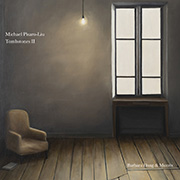 Michael Pisaro-Liu: Tombstones II [Circum-Disc]. Four years ago, Barbara Dang and the ensemble Muzzix put out a recording of selections from Pisaro-Liu’s songbook Tombstones: a set of essential distillations of song-form. Here are the rest of them, again sung by Maryline Pruvost. Again, the material and the interpretative approach can be likened to gemstones under a magnifying glass. The remaining pieces in the cycle allow for a sort of interlude to appear at times in this batch: “The outside of everything” focuses on long-held tones and beating frequencies, the stop-start of “Rattle” is intuitive but impersonal – a good analogy for the entire set. Around the middle of the album “Time may” brings everything almost to a standstill before the music becomes a little more expansive again, with the final work played here “The darkness is falling” recalling Cage’s Experiences No. 2, sung well.
 Niels Lyhne Løkkegaard, Michael Pisaro-Liu: Fata Morgana [Edition Wandelweiser]. I get the idea; but you can’t listen to an idea. First part is Løkkegaard outside somewhere idly tootling a recorder for a good while, with wind blowing into the mic now and then to remind you this is all spontaneous and artless: life with the boring bits left in. Second part is same again with fidgety electronic schmutz overlaid by Pisaro-Liu. There’s too much fiddling about for its own sake: the sounds aren’t interesting enough to reward attention but also too intrusive to be sufficently uninteresting that your attentiveness open outwards. Just looked at the cover and remembered it’s Wandelweiser.
 Bryan Eubanks: Songbook [Sacred Realism]. I can’t imagine ever getting enthusiastic for an album of soprano saxophone solos, even if it’s only about half an hour long. Eubanks plays horn: there’s electronic schmutz here too, but subtle. Is it necessary? I guess, in that the soft crunch and distorted thuds that underline the more forceful notes don’t so much punctuate the solos and ground them, pinning each one down to a flattened, cubist perspective. Eubanks’ expressive lyricism on display here is similarly cubist in its muted palettes and calm angularity, melodic lines reminiscent of Brant or Wolpe at their most serene (sorry, I’m devoid of suitable jazz references). I find it all kind of ugly but maybe your ears work better than mine for this stuff.
 Jordan Topiel Paul & Bryan Eubanks: Pushovers [Sacred Realism]. Eubanks is back to pure electronics here, applying a modular synth to Topiel Paul on snare drum. That’s not the most appetizing combination on paper either, but the two of them really pull out the stops to make it work, Paul mining the amplified drum for a surprisingly deep array of textures and timbres, using it as a source of sound more than rhythm, with smart and sympathetic treatments by Eubanks. At times the synth reworking of the drum sounds like real-time tape manipulations, giving both acoustic and electronic musicians the feel and flow of live performance – I’m guessing these are studio improvisations. They actually do achieve the “ambiguous textural and rhythmic universe where synthetic and acoustic meet” as described in the sleeve notes; that doesn’t happen every day. Each of the four tracks, ranging from five to twenty-five minutes in length, combine a dramatic sweep with attention to detail that make listening to it at home as much fun as listening to it half-cut in a noisy art club.
 Cosimo Fiaschi: unveil / unfold [Insub]. I can’t imagine ever getting enthusiastic for an album of soprano saxophone solos, even if it’s only about half an hour long. I can make exceptions though, and the two pieces Fiaschi recorded here (both on the same day, it seems) hide the source of the instrument by making each piece a study in tone – prolonged notes approach what appears to be pure, uncoloured pitch, until an added overtone or small change in breath reveals the hidden coloration. The sounds and the methods are electronic, even though both are achieved acoustically, through human means. Never quite drone, never quite ambient, Fiaschi’s pair of works carve out space into a clean acoustic shape which leaves an immediate impression that becomes more intriguing with prolonged examination.
Filed under: Music, Reviews by Ben.H
Tags: Bryan Eubanks, Cosimo Fiaschi, Jordan Topiel Paul, Michael Pisaro-Liu, Niels Lyhne Løkkegaard
1 Comment »
Loose Pianos
Saturday 31 January 2026
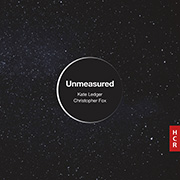 Christopher Fox: Unmeasured
[Huddersfield Contemporary Records]. Stupid here missed the Christopher Fox recital at City University this week, so I’ve been compensating by listening to his Unmeasured, a set of three recent piano pieces expertly played by Kate Ledger. There’s an intellectual playfulness lurking behind Fox’s music, to a greater or lesser degree, and it’s a little more conspicuous here, exposing a constructivist game that underpins each work which tilts the conventionally expressive into the realms of the uncanny. The album title points to the compositional theme in these three works, that of rhythm, or perhaps timing. Opening with the most recent piece, Figures of Light takes ambiguous, chromatic chords and staggers them into slow arpeggiations that are left to resonate; the result strikes the ear as a single melodic line that erratically loops and folds upon itself, stopping and starting at unpredictable moments, freezing time to reveal the particular harmonic content in each segment. Tension builds through the steady pulse of notes, broken by irregular phrasing and pauses. As mentioned above, it’s more about timing than rhythm, and Ledger’s playing adroitly tests and teases how far the disruptions to continuity can be stretched. This aspect of playing has an increasingly important role in the next two pieces. Es war einmal requires Ledger to silently read excerpts from Grimms’ fairy tales as an internal guide to the phrasing and expression of the music on the page. It takes on the surface musical appearances of animated narrative speech, yet without any conscious attempt to mimic the human voice or illustrate semantic meaning; the rhythmic cadences paired with Fox’s colourful musical material function as a story on a deeper, subverbal level, as one told to you while falling asleep. The longest and oldest work here, senza misura, gives Ledger licence to determine both the ordering of the twenty-odd sections that make up the piece and the durations given to each event. It’s mostly chordal, with Ledger choosing how the relative density and dissonance of each successive sound may be reconciled through judicious timing, treating notes on the page as a plastic material to be stretched and shaped into a complex but balanced musical sculpture. Ledger’s performance acts as a superb vindication of Fox, whether intentionally or not, composing a virtuosic rejoinder to Ezra Pound’s Great Bass theory.
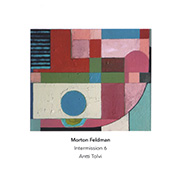 Morton Feldman: Intermission 6 [Another Timbre]. Antti Tolvi has a background of playing various instruments in experimental jazz and free improvisation, so he has a flexible sense of timing too. He takes this to an extreme in his realisation of Morton Feldman’s Intermission 6, a piece composed in 1953 for either one or two pianos. It’s one of Feldman’s most open works, despite specifying pitches: just fifteen single events notated onto fragments of staves, haphazardly scattered across a single page. The brief instructions begin “Composition begins with any sound and proceeds to any other.” This opens up all sorts of questions which cannot be easily answered, as James Pritchett has noted when he played the piece. “Can you repeat any of the sounds? and how long the piece should go on?” The suggestion of a second piano permits further speculation on how freely the piece may be interpreted. It’s a thought that has occurred to me, too, but I lack a keyboard and the ability to test it for myself. Fortunately, Tolvi has given us one answer, in the form of a solo performance that lasts a little over seventy minutes. His phrasing and articulation are unconventional, with Feldman’s usual performance note of “as soft as possible” given some leeway, allowing for a piano with recalcitrant dynamics. I’m relieved to say it’s not one of those recently-fashionable slow interpretations that treats Feldman as a pioneer of ambient music; Tolvi uses silence and near-silence as a motivating force, creating a torqued stasis that keeps the listener alert. (To answer your anticipated questions: (a) Yes it’s Feldman, but not as we know it, and (b) Great work! Don’t do it again.) The material is relatively simple even by Feldman’s standards, which does provide a lot of the strangeness; that transparency also suggests extended repetition is permissible, and Tolvi demonstrates that you can sustain this music with almost nothing.
Filed under: Music, Reviews by Ben.H
Tags: Christopher Fox, Morton Feldman
No Comments »
For Philip Guston, later
Sunday 18 January 2026
Thirteen years ago I heard the GBSR Duo of George Barton and Siwan Rhys performing Morton Feldman’s For Philip Guston in the chilly back room of an art gallery for four-and-a-half hours. On that occasion, the flute part was played by a tag-team of two, working in shifts.I remember the earlier performance being slightly rough around the edges, in a clear and sympathetic interpretation – particularly Barton and Rhys. The flute part is especially tricky, for the listener as it is for the flautist: as Feldman understood, it is a loud instrument. How should it blend with piano and celesta, vibraphone and chimes? It can tend to dominate (e.g. the rather forthright recording made by the California EAR Unit). This afternoon, at Kings Place, Rhys on keyboards and Barton on percussion accompanied Taylor MacLennan on the flutes for a new interpretation of the piece, to launch their recording of all three of Feldman’s large trios. In this version, their understanding of how the three musicians relate was clear, with the flute primus inter pares in what aspires to be a soliloquy of the simplest and most elemental gestures, complicated by piano and percussion mirroring and echoing the parts in a fraught balance.
The immediate impression when they started playing was that they understood the dynamics, with MacLennan’s flute as gentle as possible (allowing for the impossibility of a quiet piccolo). I shouldn’t have to tell you that GBSR have better chops now than when they were kids. Barton plays mallet instruments with supreme softness, just enough to be heard through the hall. Rhys made her two keyboards blend seamlessly with Barton’s playing and with each other, creating a mercurial compound instrument. MacLennan seemed indefatigable, giving the audience full licence to find a wide range of interpretations alluded to in the programme notes without ever needing to emote. The spare, unadorned material and thin textures made substance from outlines. While I expected some degree of raggedness to inevitably creep in over time, the trio maintained a dignified stillness throughout, with a suprising consistency in sound where any tiredness was sensed and expected rather than aurally present. Better still, they maintained a flow throughout the piece’s excessive length, minimising the tendency in Feldman’s writing to create a series of episodes that inevitably wind down before starting over.
I mentioned before that I hear this piece differently every time. In the subterranean recital room of Kings Place, with such disciplined musicians, there were no external cue to the passing of time. The piece seemed longer than I remembered, particularly as it started to double back upon itself. This, with the way the trio played, left me at times entirely disorientated. I started finding certain passages too long, or too inert, then suddenly becoming alert and enthralled again, for no evident reason – this composition is a cussed beast. Like too many things in life, I wanted it to be over while knowing I’d be sad when it was done. (Why does he bring in the piccolo so early in the piece?) It all comes together in the long ending and coda, possibly the most audacious and subtle of Feldman’s compositional tricks. I need to hear MacLennan, Barton and Rhys’s recording of it soon, along with their versions of Why Patterns? and Crippled Symmetry.
Filed under: Music, Reviews by Ben.H
Tags: Morton Feldman
No Comments »
New Year Weirdness
Saturday 3 January 2026
Back from a break, but before I left I was able to hear Magnus Granberg and an expanded version of the group Skogen play Trouble, Had It All My Days in London. Thirteen musicians, with locals and Toshimaru Nakamura on his no-input mixing board adding to the colour and texture. After just going through some of his other recent compositions it was a pleasure to hear this work live, there being no recording available yet. Apart from the innate theatre of experiencing the music live, the piece showed another subtlety to Granberg’s approach, using his source (alluded to in the title) both as material largely untraceable for the unprompted listener and as inspiration for the direction the composition will take over its lengthy course. There is notated music, but it’s pooled as a resource for improvisation and repetition as directed; despite this apparent freedom in details, the piece is shaped to head from activity to quiescence. Sustained, simple textures predominated as the piece progressed, with fewer changes or overt disruptions from Granberg’s usual resources of ambient electronics and percussive small objects. (Nakamura’s feedback sounds were occasionally a distraction, but these appeared to be down to getting the balance right on his finicky electronic setup.)
 Pacha Wakay Munan: El tiempo quiere cantar [Buh]. I need to talk about two of the most downright weird albums that came in last year. El tiempo quiere cantar is on the Peruvian Buh label, credited to Pacha Wakay Munan – a duo of musicians “and researchers” Dimitri Manga Chávez and Ricardo López Alcas. The sleeve notes somewhat modestly describe it as a “showcase” of the sonic possibilities of pre-Hispanic South American instruments in a contemporary musical context. Listening to it sounds like so much more than a demonstration; the strangeness is multiplied by the absence of a convenient musicological or anthropological basis to rationalise what you’re hearing. You’re already thinking of pan pipes, rattles and drums, but this collection of eight pieces will periodically reinforce your preceonceptions only to confound them. As described in the notes, the instruments survive but their method of use has largely been lost, leaving any existing tradition a piecemeal assembly of repurposed practices. This gives our two musicians the freedom to invent a new context, which when heard as an album appears to be created on the fly, drawing in references to older ethnographic recordings, adding occasional European instruments and modern electronics. It becomes impossible to hear this music for what it is, as our heads are already filled with pre-existing interpretations of what it should or should not be, thus rendering even the familiar at odds with our expectations. It’s worse if you’re better educated to prioritise the “authenticity” of ethnic experience, as your aesthetic values become more prescriptive and constricted. The music shares Kagel’s understanding of slippery, subjective relativism which more dogmatic musicians attempt to deny. As with Kagel, it’s hard not to think there’s some conceptual programme at work behind the album when hoarse, distant whistles are succeeded by a slightly sentimental piano accompaniment to a siku melody, before suddenly giving way to a chugging vamp overlaid with braying ceramic trumpets. You can tie yourself in knots trying to intellectually justify it all on the musicians’ behalf, or just let it happen to you and marvel at the sonic variety.
 Jason Doell & Naomi McCarroll-Butler: FOUR FORMER MYRRH FORMERS FORMED HER HORN FOR MURMURS [Watch That Ends The Night]. The hell? Bunch of gamelan-cum-windchime sounds that appear to be played by a machine, Fifties musique concrète noises with a zither, fidgety electronic noodling with insouciant clarinet fripperies? Waat is this all supposed to add up to? It isn’t, and I’m not hearing it right; I’ll spare myself some embarrassment and say the misdirection is part of the point. McCarroll-Butler is the (very) human musician, and Doell (I should have known) has wrong-footed me again with his algorithmic programming. All three (computer code included) are jointly credited with composition. The sleeve notes offer “improvisations sampled and algorithmically composed” and that’s it. No wonder each of the four pieces here remain uncrackable nuts of inscrutability, but what particularly bamboozles the listener is how the choice of instruments, manner of initial playing and computational reorganisation defy the usual impassive mood that prevails when hearing non-human (or sufficiently alien) cultural artefacts: there always appears to be something at stake. To drive this point home, the final, long track glides effortlessly on a buzzing, chiming drone that could seemingly go forever, until a saxophone creeps in until it’s front of stage and joined by a drum kit in an ambivalent homage to Yoko and John’s Cambridge 1969.
 Harry Partch: The Wayward [Bridge]. A welcome piece of vintage weirdness is the latest instalment of Bridge’s series of fresh interpretations of Harry Partch, beautifully recorded and played by the Partch Ensemble. The Wayward is a sequence of five compositions Partch identifies as a suite, which until now hasn’t been collected into a complete recording it says here. Partch’s time as a hobo in depression-era America is the subject matter here, so his signature earthiness is at the forefront. That earthiness can make one want to prefer the gentle crustiness of his own recordings from the Fifties and Sixties, but the world owes him these crystal-clear renditions on lovingly recreated instruments to renew his legacy in the next century. That said, what immediately struck me is how damn well Partch’s original ensemble played his weird-ass music at the time; these new recordings won’t make you re-evaluate anything, but they will give you greater appreciation of Partch’s compositions as living music more than historical arefact. There’s still plenty of history here: Partch is one of the great exponents of that explosion of vitality in American English in the mid-20th century. The exotic instruments and tunings all serve to provide thrilling music more than exemplify a theory – one advantage of these new recordings is that the instruments don’t fade into the background. The Partch Ensemble’s musicianship and recitations are spot-on, capturing the zeitgeist of the language as well as can be expected without lapsing into pastiche. Veteran just-intonation guitarist John Schneider is the main narrator and his voice has gained a rasp with age that bears an uncanny similarity to Partch’s own. This take of U.S. Highball is a keeper, and if Barstow runs the risk of being overfamiliar in your household then the unbridled vocabulary used here will still make you perk up. The new item with this release is the alternative versions of Ulysses at the Edge, one with added improvisation on trumpet and baritone sax from when Partch envisioned the piece as a vehicle for Chet Baker.
Filed under: Music, Reviews by Ben.H
Tags: Harry Partch, Jason Doell, Magnus Granberg, Naomi McCarroll-Butler, Pacha Wakay Munan
No Comments »
Granberg, Granberg and Granberg
Wednesday 26 November 2025
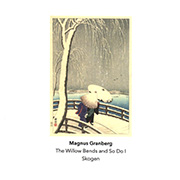
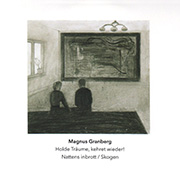 Magnus Granberg: The Willow Bends And So Do I; Holde Träume, Kehret Wieder! [Another Timbre]. The two most recent Granberg releases on Another Timbre give you both the truth and the lie behind the observation of “always different; always the same”. When Holde Träume, Kehret Wieder! came out last year I lost track of it in the shuffle of events at the time, then was spurred to recover it when The Willow Bends And So Do I cam out. Can I tell them apart? At least as well as I know my Bach(s). Would it matter? No. I needed a better context, so I listened to these in succession variously with some of his older works, such as 2012’s Despairs Had Governed Me Too Long and 2013’s Would Fall from the Sky, Would Wither and Die. Granberg’s compositions typically play out over 45 to 60 minutes, so they don’t lend themselves readily to comparison testing. From this perspective, Despairs sounds more withdrawn and furtive than before, Fall testing how far it can act out without risking the overall form. Over the years, Granberg and the core group of musicians he has worked with have developed a clarity of purpose in playing these works, still highly sensitive to the delicate environment each piece creates, while being confident enough to speak out when needed.
Holde Träume, Kehret Wieder! was composed in 2021 and is presented here in two versions, a septet performed by Skogen and a version played by the quartet Nattens Inbrott. Both were recorded in the same studio in Stockholm in November that year; both ensembles include Granberg himself and percussionist Erik Carlsson. Granberg’s signature prepared piano, common to almost all the recordings of his music I’ve heard so far, plays a slow and fairly steady succession of isolated sounds which act as vertebrae around which each piece is built. He draws upon other music for his material, ranging from old pop songs to Schubert, but any direct reference is sublimated through slowness and by pooling resources between the musicians who often play on the threshold between pitch and non-pitch. Sounds are shared and exchanged through a loose but organised dialogue (I’m still think about Guðmundur Steinn Gunnarsson here). I’m going to venture that the flavour of each piece comes from the rarefied sentimentality captured in the source material, even as its appearance has been transcended. Holde Träume focuses on stillness and texture, falling into sections defined by the amount of surface activity. The quartet version is all acoustic; the septet adds the electroacoustic elements of amplified objects, friction. The septet take is still transparent, not much less empty, but with an expanded range of low sounds and faint noise. The Willow Bends And So Do I was composed in 2024, with Skogen appearing here as a nonet with some new members. Melody, in its own strange way, is present throughout and the piece progresses through its sixty minutes in a continous form, with changes across the piece made by periodic alterations to melodic patterns and shifting roles for timbre with each instrument. Musicians exchange foreground and background roles, producing an intricate counterpoint. The dynamics are gentle but firm throughout, without any semblance of reticence. It captures the experience I recall of hearing them play live. Speaking of which, I may even leave the house to hear Skogen again this weekend, a 13-piece band playing Granberg’s 2023 piece Trouble, Had it All My Days.
Filed under: Music, Reviews by Ben.H
Tags: Magnus Granberg
1 Comment »
Two more long-ass piano pieces
Sunday 23 November 2025
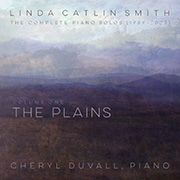 Linda Catlin Smith: The Complete Piano Solos (1989-2023), Volume One: The Plains [Redshift]. The promised edition of Linda Catlin Smith’s piano music begins at the end with her most recent work for the solo instrument. The Plains is an hour-plus excursion in a single movement, composed at the request of the pianist heard here, Cheryl Duvall. (Duvall has previously appeared on Dark Flower, a set of Smith’s solo and ensemble pieces.) This is an unusual piece for Smith, marking a new and potentially disturbing direction in her work. She has composed long works before (an opera, the multi-movement violin and percussion duet Dirt Road) but in comparison The Plains are unadorned, even barren. It begins with a single note held for fifteen seconds, then a single chord is reiterated in a monotonous vamp. The vamp eventually opens up into more diverse forms, with changes in chords and rhythm until the idea is more implicit than heard. There are sectional changes throughout the work, but everything sounds at first as background, an accompaniment to a melodic line that always seems imminent but never appears. New developments are always muted, more apparent in retrospect, obscured by the music remaining steadily in the lower middle register. When something melodic finally appears, it’s as a slow figure in the bass. We’re about halfway through before any higher-pitched notes make their presence felt. I assume that Smith and Duvall each worked on this piece with the aim of making it as resolutely unobtrusive as possible and thus, like on a long journey through open landscape, impress with an unyielding image despite any surface variations along the way. Duvall gives attention to the smallest differences in dynamics and voicing to produce a wide landscape in low relief. That landscape is not so much forbidding as indifferent, much like the one evoked Kory Reeder’s string quartet Homestead, alien to European experience and where the pleasures to be taken from it are not immediately obvious to a newcomer. Three more albums of Smith’s piano music are in preparation, and Duvall has been commissioning hour-long pieces from other Canadian composers. Point of order: those are hills on the cover.
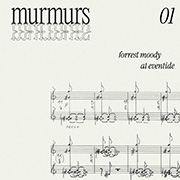 Forrest Moody: at eventide [Murmurs]. Moody himself is the pianist for this seventy-minute solo composition. This is all I know of his stuff as a composer (he has played on some of Eden Lonsdale’s ensemble pieces). I don’t want to call at eventide an obsessive work, so let’s just say that Moody is very thorough here. The beginning of the score on the front cover gives you an idea: closely-positioned chords with an emphasis on overtones, secco. Any feeling of flow from one chord to the next is blocked by the dead stop between one chord and the next. Industrious use of the pedals control the release and choke of lingering tones, giving at times some uncanny filtering effects to the chords. The piano is close-miked, so the soft thudding of the dampers and pedals throughout the work add a tensioning counterpoint to the steady succession of string sounds. As with the Smith piece, it starts out with a narrow range of pitch; unlike Smith, Moody doggedly stays within this frequency band, rarely ventilating the close atmosphere with an occasional bass note or a slow run of single notes that ascend into the treble. As with many other long works, it settles into its own sense of time and thus creates a space in which it may be contemplated on its own terms, but with its determination to dwell upon the same spot for so long it can become enervating. Moody’s musical ideas do start to soften up in the latter half, once in a while at least, and so some development of character does arise of its own accord. Despite this, once those ideas have been illustrated, it does feel like he runs out of things to say: the piece benefits from being long, but nothing about it seems to insist that it must be this particular length. Except perhaps, for the sake of endurance, that we follow Moody with every step as he pursues this line of interrogation; not necessarily obsessive, just thorough.
Filed under: Music, Reviews by Ben.H
Tags: Forrest Moody, Linda Catlin Smith
No Comments »
Liza Lim: String Creatures
Sunday 26 October 2025
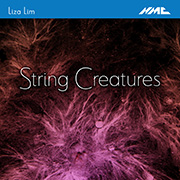 Liza Lim: String Creatures [NMC]. I’m just back from vacation and feel like apologizing for not writing about this album as soon as it came out last month. Even for listeners familiar with Liza Lim’s work, String Creatures is a revelatory and at times astonishing insight into her transformative music. The four pieces presented centre on perfomances by the JACK Quartet in Melbourne last year and were composed between 2014 and 2022. The title work that leads the set is a large quartet that would seem to dominate the album, at first: it grabs your attention from the first moment with its opening violin aria played in a sour and resonant baritone, an uncanny effect achieved by tuning the bottom string an octave lower. Lim has fashioned a unique and remarkably coherent language for string instruments, achieved through a synthesis of eclectic influences and empirical experimentation. Extended techniques are likely as not to be drawn from other cultures such as folk fiddling (Hardanger and Bluegrass) as from the postwar avant-garde. The most extraordinary thing about String Creatures is that, even with its dazzling array of new sounds and extremes of colouration, it always feels like the effects are a natural means to an end, producing a complex expressive statement on the relationship between physical activity and emotional need: a Romantic disquisition made through a renewed, corporeal language.
On that corporeality: I remember many, many years ago attending a public workshop of Lim’s early string quartet Hell. After the first run-through, she told the musicians they were playing the notes too well. Where her score called for notes to be played hard, or faint, or off-pitch, she really wanted the physical impact to be heard and felt, removing the quartet from being a sophisticated ensemble and towards becoming an organic complex, all sound as a product of friction and breath. With the JACK Quartet, Lim pushed this line of thinking much further: “Lim asked the players to learn rope tricks and to literally tie each other’s hands to their instruments, exploring the sounds that resulted as the musicians struggled free.” Having learned the music inside-out, as it were, it follows that JACK’s playing of these challenging pieces is entirely fluid and eloquent, speaking in strange intonation, nasal falsetto and harsh gutturals with a discursive flow as though it were their mother tongue.
So there are strings and there are strings: JACK cellist Jay Campbell plays solo on an ocean beyond earth, on two instruments; or rather between two instruments. Each string on his cello is attached by a rosined thread to a string on a retuned violin; pulling on a thread sets off faint resonances between the two instruments. It’s a still, otherworldly work that finds portent in its quietness, fitting the subject matter that inspired it, of interpreting a signal received from space. The perception is clear even as the outline is diffuse. The brief The Weaver’s Knot is a string quartet which compresses the activity of its argument into a single movement a little over five minutes long – it’s short but not small. For the final work, The Table of Knowledge, JACK is joined by Rohan Dasika on double bass. The deeper pedal tones play off against odd harmonics, creating a queasy, distorted form of exotica. The knowledge Lim alludes to can be discerned from the titles of each movement: Datura, Belladonna, Henbane, Cannabis. It’s a heady mix of the alluring and the repellent which has underlaid her music all the way back to her early chamber piece Garden of earthly desire, an embrace of the uneasy relationship between the physical and the spiritual that makes her otherwise esoteric idiom so compelling. The long final movement, “Flying”, transcends what has gone before it with a strange solo by Dasika, playing bass while holding a taut thread in his mouth, attached to the bass’s top string. His mouth acts as a resonator, producing a kind of overtone singing multiplied by the sympathetic vibrations of the instrument. As a final transformation, he music floats somewhere between bowed string and voice, never fully one nor the other, at once more than and less than human.
Filed under: Music, Reviews by Ben.H
Tags: Liza Lim
No Comments »
A moment’s pause
Tuesday 30 September 2025
 Huw Morgan: Melos [Sawyer Editions]. Life’s been a little crowded lately so I’ve been finding some breathing space. Huw Morgan’s Mostly Slow Organ Music recitals have been happening for a while now, featuring his own compositions amongst others. His Melos compositions have been spreading out across the country for ten years now: this album features organs from churches in Bristol, Dundee and Catford. They’re not exactly performances on the organ, but with the instrument; Morgan treats each iteration of the piece as a site-specific work, taking long samples of individual stops and composing them into a single chord that gradually transmorphs through electronic manipulation into a second chord. Extraneous sounds and impurities in the mechanism are preserved, and the sliding tones are too slow to be perceptible as the music’s subject. The result is a Zen-like drone, empty yet full, the well-composed sort that hold your attention without seeming to do anything. When you start to lock in on it you become fascinated by the near-imperceptible change in intonation and the multitude of sonic ramifications it brings about. Five versions are presented here, the shortest being eight minutes and the longest (twenty) being only an excerpt from a longer piece. Hopefully more recordings become generally available.
 Ben Richter: Dissolution Seedlings [Sawyer Editions]. The ensemble House on Fire consists of three musicians, at least in this instance; they play pianos, but also melodicas, a pump organ, percussion and a cello. Dissolution Seedlings is a nearly-hourlong work for this odd ensemble, divided into fourteen (“and a half”) movements. Offset against this information is the curious way the music dissipates its activity, marking out time more than passing through it. Richter speaks of rhizomes (more vegetal than anti-Oedipal) in his notes, but the piece struck me most as a way of finding music that endures past the point when all momentum has been exhausted. It reminded me a bit of Charlie Usher’s An assembly – a forty-five minute piece composed of a hundred-plus tiny fragments – but whereas that piece uses brevity as a means of negating substance, Dissolution Seedlings creates space and hesitates to fill it. Each movement is its own pause, where waiting is an end in itself. Small gestures emerge almost by default, and with each change of state from one section to the next, House on Fire does as much nothing as they can possibly sustain for the duration.
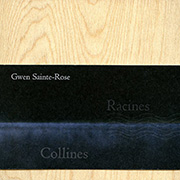 Gwen Sainte-Rose: Collines / Racines [By the Bluest of Seas]. No need for philosophising or head-scratching here. This is just Sainte-Rose straight up with a cello and a loop pedal. It’s bright and colourful and seems all so clean and simple, swear it’s all been done before but no direct comparison immediately comes to mind. That’s not the sort of thing you should be worrying about anyway when this is so pleasant to listen to. Sainte-Rose says she’s rhapsodising the Belgian landscape, but I think we can all invest these two long, drifty pieces with our own ideas of home.
 Marti Epstein: For Jack [Sawyer Editions]. The “Jack” referred to here is Jack Yarbrough, the pianist playing this long, solo work. Yarbrough’s been heard in a few other recent recordings, notably Timothy McCormack’s mine but for its sublimation, another work written for him. At that time, I wrote that “he has a gift for coaxing prolonged sounds out of his instrument”; that quality applied here too. Unlike the other pieces in this review, For Jack doesn’t exactly create mental spaces for contemplation, rather it crowds them out and then colours those spaces with its own, foreboding mood. For a long time, the piece dwells upon dark clouds of low chords, which ultimately burst out with sudden violence. Eventually, the mood breaks a little, opening into higher registers and more open sounds, but the chords are still dense and brooding until they finally fragment into slow counterpoint of higher single notes. My description makes it sound cheesy, but Epstein steers a steady course between cheap drama and cold process, making the progression seem intuitive and unforced. Yarbrough emphasises this with an interpretation which properly equates intuition with nature, merging the austere and forbidding with echoes of the pastoral.
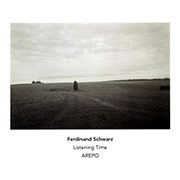 Ferdinand Schwarz: Listening Time [Another Timbre]. I don’t know anything about Schwarz and neither did the label proprietor before he heard this, it seems. A work for clarinet, electric guitar, accordion and cello, played by the AREPO ensemble, it’s an unexpectedly beguiling piece. Listening Time starts out self-effacing and innocuous but it grows on you after the first hearing. AREPO plays a single chord, its pace seemingly dictated by the clarinettist’s breath. Over each iteration, the chord spreads out a little but mostly it deepens, with subtle touches that hint at possible voice-leading. Without the need to “go” anywhere, composer and musicians settle into establishing where they already are and what that might entail. It’s a piece you need to listen into, much in the same way as the musicians of AREPO appear to. Schwarz describes as improvisation, petrified in time, and credits the AREPO musicians jointly with composition. The ensemble sounds perfectly matched to the piece, producing softly luminous sound as a single complex instrument, with the idiosyncrasies of the individual instruments sublimated into a greater whole.
Filed under: Music, Reviews by Ben.H
Tags: Ben Richter, Ferdinand Schwarz, Gwen Sainte-Rose, Huw Morgan, Marti Epstein
No Comments »
The return of 840 and a bonus Music We’d Like To Hear
Thursday 25 September 2025
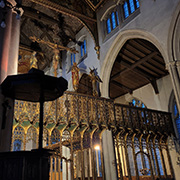 The 840 concerts in London were part of the long-vanished pre-Covid world and one which I had thought was gone for good, so it was a welcome surprise to see it resurrected with minimal fanfare after a five-year-plus hiatus. Can one go home again? Not exactly, as the concert last Saturday had relocated from their once-regular Islington haunt to St Cyprian’s, Clarence Gate. Otherwise, nothing seemed to have changed, with a programme that retained the same quietly reserved and very slightly precious mood that has become the series distinctive style. As usual, the instrumental forces were modest: works for two violinists and for piano duets. The gig began with the most prickly piece of the night, Marc Sabat’s Three Chorales for Harry Partch, a duet for retuned violin and viola. The earliest of his compositions, it draws on his career as a violinist and his study of microtonality to view Partch’s own use of microtonality under a microscope, creating a work of buzzing, vibrating slow-motion slewing, all subtones and doublestops. The two string players were Amalia Young and Anne Yin Han (apologies for not knowing which one played viola), who showed serious intent whether playing Sabat or arrangements of Diego Ortiz’s viol Recercades. The Ortiz pieces were interspersed through the night, having been arranged for violins by concert series curator Alex Nikiporenko. Co-curator Christian Drew indirectly echoed these pieces with his violin duet 17th Century Music, which struck me as a loose but airy collection of gestures toward the baroque era, minus the drive. (This is at least the second, possibly the third piece I’ve heard whose title riffs on Laurence Crane’s 20th Century Music – strange how influences can spread.) Darius Paymai’s sonnerie, air was another of the new pieces written for this concert and took a similar approach to Drew, this time giving Satie the languid treatment. The strongest of the new works was Nikiporenko’s Thread, an affecting violin duet that gained effect through taking intimate personal and sentimental inspiration to produce music that was securely woven together yet always translucent. The two pianists were Jay Austin Keys and Fernando Yada, who presented a suitably sensuous interpretation of Linda Catlin Smith’s Velvet which seemed to focus on the immediacy of touch ahead of overall shape, and a suitably dense version of Egidija Medekšaitė’s Textile 1 which reduced differentiation in the ever-changing small differences of interplay into a tight, seamless surface. The final work combined violins and pianos, James Creed’s Plain Song using sustained tones from an e-bow on the piano strings over which the musicians would sparingly add one or two notes to harmonise on the faint outline of a song.
Creed also began the evening’s music, earlier at St Mary At Hill, at a free matinee concert given by Music We’d Like To Hear as part of London’s Open House weekend. Some curious punters who attended were quietly bemused by the works presented, a typically eclectic mix combining rarefied sublimities and literal piles of junk. Creed’s piece Lomond was written about five years ago but used the same method of Plain Song, this time producing faint traces of Loch Lomond out of the piano strings’ resonance. This time, the concept behind the work seemed to hold the piece together better. The programme was curated by Laurence Crane (q.v.) and featured the “GSMD Experimental Music Workshop and guests”, including Tim Parkinson and Angharad Davies. A scene from Parkinson’s opera Time with People (written about here earlier) was presented, performers crouched over small piles of aforementioned rubbish and producing a surprisingly broad palette of sounds from them as they muttered stop-start in unison. It made the following performance of Pauline Oliveros’s Rock Piece sound strangely monochromatic by comparison. John Lely’s Symphony No. 3: The Parsons Code for Melodic Contour is a near-unison work of blunted melodic obstinacy; the occasional deviations out of tune should undermine its solidity but instead just make it seem more threatening. Conversely, a rerun of Amber Priestley’s woozy derive Did not feel very well at skool (31/1/1977) became insidious by its dissipation, with the musicians scattered around the hall brewing up a thin but ominous musical miasma.
Filed under: Music, Reviews by Ben.H
Tags: Alex Nikiporenko, Amber Priestley, Christian Drew, Darius Paymai, Egidija Medekšaitė, James Creed, John Lely, Linda Catlin Smith, Marc Sabat, Pauline Oliveros, Tim Parkinson
No Comments »
What Is Going On
Monday 22 September 2025
 Olly Sellwood: Charlene from Big Data and other stories [Surface Press]. Up front is Peter Falconer’s narration, backed by the duo of Eva Zöllner and Heather Roche on accordion and clarinet. Falconer makes for an engaging raconteur, giving each of these half-dozen five-minute vignettes much-needed expressiveness and lucidity, despite the tricksy overdriven autotune threatening to smother him and make him hop about like a marionette. The Zöllner-Roche Duo are delightfully agile, seemingly unencumbered by tech and switching on a dime from one caricature to the next and hitting their dramatic marks with pinpoint accuracy. In the background, the music is composed by Olly Sellwood and the texts are written by Rose Biggin and Keir Cooper. I am not a fan of this sort of thing: the whole exercise is shot through with that particular British style of apologetic jokiness that makes a virtue out of pulling its punches, which I find irritating. I haven’t gone back to check but I would be surprised if Falconer doesn’t actually say “mustn’t grumble” at some point. Much of the zeitgeist (the autotune, the tales of frustration with automated customer help lines) is five minutes ago, but the whole thing is almost entirely redeemed by many of Biggin’s and Cooper’s stories turning in upon themselves from the absurd to the oblique, becoming more interesting as they make less sense. And Sellwood’s instrumental writing maintains the humour without resorting to stunts, accordion and clarinet providing lively backgrounds and interested commentary, somehow sounding more than the sum of their parts.
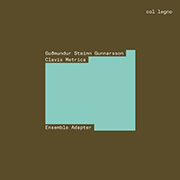 Guðmundur Steinn Gunnarsson: Clavis Metrica [Col Legno]. The latest dispatch from planet Gunnarsson reveals more details while deepening the mystery of this singular oeuvre of compositions. As when learning a new language, the moment-by-moment activity seems inscrutable and at first undifferentiated, but patterns start to appear; those patterns in turn present a new challenge to the listener. Clavis Metrica is a vividly recorded work from 2022 performed by Ensemble Adapter, a group of four musicians without direct participation of the composer. A large-scale work comprised of eighteen sections, featuring flute, clarinet, harp and the signature array of rattles, whistles and harmonicas, it gives you the opportunity to immerse yourself in the sounds and discern a suggested outline of the intricacies of their ebb and flow, fighting the impulse to analyse everything like an ethnomusicologist. Listening to this, some things came to mind. First, stop hearing those rattles and whistles as extraneous texture. Second, reading into the background of the piece made me realise that I had missed something that should have been obvious to me from the start. Gunnarsson’s use of mobile, animated notation had a motivation beyond openness of structure and detailing; it’s about rules which are understood without being codified. Writing about Clavis Metrica, Gunnarsson discusses his experience of Icelandic versification and how it is felt through poetry, folk balladry and debate. This summary is a rough approximation of certain points, all to do with the pervasiveness of verbal poetic meter through lived experience of spoken communication, exchanged through a system of rules applied with greater or lesser formality. I’d somehow neglected this despite my introduction to Gunnarsson coming from hearing his orchestral piece Sporgýla all those years ago. The fluidity of structure, the informality of the instruments, with each piece he’s trying to achieve a heightened form of conversation. The only downside to this release is that it’s on the very serious Col Legno label so you don’t get the funky cover art that adorned Gunnarsson’s previous releases.
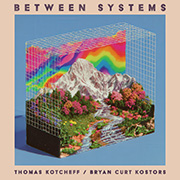 Thomas Kotcheff & Bryan Curt Kostors: Between Systems [Post Tonal]. Disgusting. Old farts will remember the new millennium’s brief fad for “remixing” Steve Reich, an exercise as fatuous as wallpapering the Eiffel Tower. As another sign that things have only gotten worse, pianist Thomas Kotcheff has teamed up with Bryan Curt Kostors on modular synths and various electronica to produce a set of chill-out mixes of pieces by Morton Feldman and John Cage. The Feldman pieces are brief solo piano works from the early Fifties: all five Nature Pieces are played, some with “Beats”. The piano is “Glitched”. Sounds are backmasked, harmonic layers are expanded and each piece’s “growing energy” and “climax” are heavily underlined with various safety colours for the benefit of those too thick to hear much of anything when subjected to the original. I’ve never felt so confident that I’m not a fuddy-duddy as when I say that this sucks; not because it’s trying something new but because that new thing is a dull parody of clueless newness for its own sake. Not just that it’s uninspired, but it’s airily dismissive of the actual music they’re interpreting, as though Feldman and Cage are blank canvases for Kotcheff and Kostors’s doodling. (The sleeve notes come with “Track Narratives” which detail the process used to treat each track, reading much like the menu at a pretentious eatery describing how they’ve seasoned your pulled pork. I’ve also learned that “Nature Piece 4 is among Feldman’s most popular works”.) For the rest of the album, the pair appear to have run out of ideas and settle into treating all the resonant pauses between Intermission 3 and Intermission 5 as free space to fuss and fidget about in like an unwitting toddler at Wigmore Hall. They do the same fidgeting for two Cage pieces: with tedious inevitably, they are Dream and In A Landscape, a pair of works subjected to so much midwittery over the years I have come to almost hate them.
Kotcheff made a fine recording of Rzewski’s Songs of Insurrection not too long ago, which just makes things worse as he should know better. This LP isn’t out till next week so I don’t have a link to where you can buy it; instead I’ve link to the promo for last week’s launch party in LA. We’re asked to “think of Tony Bennett’s rendition of The Beatles’ “Eleanor Rigby””, although I don’t recall Bennett attempting to beatbox on it. The programme also credits Celine Dion with writing “The Power of Love”.